Christianity is One Great Miracle – The Grand Miracle by C.S. Lewis

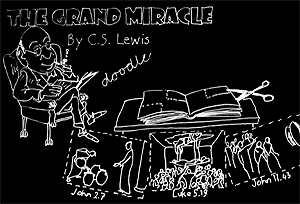
The Grand Miracle by C.S. Lewisby C.S. Lewis
One is very often asked as present whether we could not have a Christianity stripped, or, as people who ask it say, “freed” from its miraculous elements, a Christianity with the miraculous elements suppressed. Now, it seems to me that precisely the one religion in the world, or at least the only one I know, with which you could not do that is Christianity. In a religion like Buddhism, if you took away the miracles attributed to Gautama Buddha in some very late sources, there would be no loss; in fact, the religion would get on very much better without them because in that case the miracles largely contradict the teaching. Or even in the case of a religion like Mohammedanism, nothing essential would be altered if you took away the miracles. You could have a great prophet preaching his dogmas without bringing in any miracles; they are only in the nature of a digression, or illuminated capitals.

But you cannot possibly do that with Christianity, because the Christian story is precisely the story of one grand miracle, the Christian assertion being that what is beyond all space and time, which is uncreated, eternal, came into Nature, into human nature, descended into His own universe, and rose again, bringing Nature up with Him. [Read more…]

The Heart of Worship is Surrender to God

Heart of Worship is Surrender to God by Rick Warren –
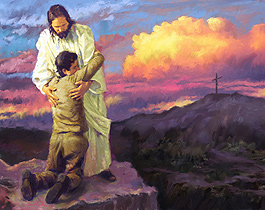
The heart of worship is surrender. Surrender is an unpopular word, especially in the American culture. Surrender means, to many, defeat. We love winning so surrender is unthinkable. But surrendering to God is the heart of worship. It is the natural response to God’s amazing love and mercy. We give ourselves to Him, not out of fear or duty, but in love, 1 John 4:9:10, 19. Paul urges us to fully surrender our lives to God in worship, Romans 12:1. There are three barriers that block our total surrender to God: fear, pride and confusion. We want to control our own lives so we misunderstand the meaning of surrender.

1. Can I trust God? Trust is essential to surrender. I won’t surrender to God unless I trust Him, but I can’t trust Him until I know Him better. Fear keeps me from surrendering, but love casts out all fear. The more I realize how much God loves me, the easier surrender becomes. How do I know God loves me? God says He loves me, Psalms 145:9. I’m never out of His sight, Psalms 139:3. He cares about every detail of my life – Matthew 10:30. [Read more…]

Tolerance and Charity, from a Christian Perspective

Tolerance is Not a Christian Virtue by Brian A. Graebe –
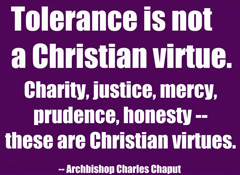
Tolerance is a nice word, but is it a Christian virtue? Archbishop Charles Chaput of Denver doesn’t think so, and his claim has occasioned no small amount of protest. In a smug editorial, America magazine recently chastened Chaput for coarsening the tenor of intra-ecclesial discourse. While no call for courtesy and civility should go unheeded, an apology for toleration that ignores its niceties only furthers the intellectual and moral torpor plaguing the public square.

Proponents of a kinder, gentler discussion on the great issues of our day often attempt a rhetorical sleight of hand, coupling tolerance with charity. Such a pairing is ambiguous at best. The call to charity “loving one’s fellow man as a child of God” is universal and, one hopes, uncontroversial. But what does it mean to be tolerant of those with whom we disagree on serious matters? If used as a synonym for charity, combined patience and magnanimity, one can make a case, but that case remains weak and the term imprecise. [Read more…]

St. John Chrysostom on the Terrible Passion of Homosexuality

St. John Chrysostom virtue of faithby Fr. Sarantis Sarantou –
“Because of this did God give them up to dishonorable passions, for even their females did change their natural function into that which is against nature; and in like manner also the males having left the natural use of the female, did burn in their longing toward one another….” (Romans 1:26-27)

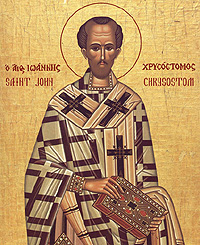
The Apostle Paul, according to the Holy Fathers, is the holy mouth of Christ, and divine Chrysostom is the mouth of the Apostle Paul. Commenting on the very important Epistle to the Romans of the holy Apostle Paul, the divine Father gives a divinely inspired analysis of homosexuality, among other issues.

All the passions are degrading to humanity, but especially the mania of men for men. He summarily characterizes homosexuality as an unforgivable passion, not because it really is, but because the entire male personality becomes so distorted that there is a chronic allegiance to this abomination, which is a difficult passion to restrain by the fallen.

The golden words of Chrysostom are remarkably balanced. His unshakable logic, which he uses to spiritually support his flock, is universally acknowledged to be inspired by the Holy Spirit. [Read more…]

The Image of God and the Dignity of Work

The Image of God and the Dignity of Workby Art Lindsley –
The number one fear of the millennial generation is living a meaningless life.

In a recent informal survey of undergraduate students at Regent University, 27 percent of students asked expressed anxiety when considering their vocation. “Scared,” “uneasy,” “unsure,” “confused,” and “apprehensive” were common words in describing the way they felt about their future vocation.

But college students aren’t the only ones struggling with their calling. Many adults fail to discover their calling in life, too. Why is it so hard to find this thing we call our “vocation”?

When I use the words “calling” and “vocation,” I am referring to what Os Guinness calls our secondary calling. As Guinness points out, along with Luther, Calvin, and many other Reformers, our primary calling is the call to faith in Christ. Several secondary callings flow from this primary calling, including the call to work. [Read more…]

What is the Meaning of Life?

Hieromonk Job (Gumerov)

by Hieromonk Job Gumerov –
Man has given thought to the meaning and purpose of life since antiquity. The Greeks had the myth of Sisyphus, king of Ephyra (Corinth). As punishment for his deceitfulness, in the underworld he had to roll an enormous rock up a mountain for eternity. But as soon as he reached the peak, an invisible force propelled the rock back down to the bottom – and then the same pointless labor began all over again. This is a striking illustration of the meaninglessness of life.

In the twentieth century, the writer and philosopher Albert Camus applied this image to modern man, judging the central feature of his existence to be absurdity:

“At that subtle moment when man glances backward over his life, Sisyphus returning toward his rock, in that slight pivoting he contemplates that series of unrelated actions which become his fate, created by him, combined under his memory’s eye and soon sealed by his death. Thus, convinced of the wholly human origin of all that is human, a blind man eager to see who knows that the night has no end, he is still on the go. The rock is still rolling.” [Read more…]

Doubt Should Not be Feared

Metropolitan Anthony
by Metropolitan Anthony of Sourozh –
I have been posed a question about doubt. People fear doubt. But they fear in vain, because doubt comes into being when we do not know the truth in full and pose a question.

I will give an example. I once occupied myself with science. One of the characteristics of scientific progress is the calling into question of everything of which you had previously been certain.

When a scientist gathers facts, they are at first uncoordinated. Then he gathers them together, and some kind of general picture emerges. It seems integral. At this point, if he is a true scientist, he will pose a question to himself: where are the cracks? I will search for a fact that will dismantle the integrity of my conception, since my conception is limited.

All science in general consists of collecting facts, arranging them into a single whole, and then calling this whole into question [Read more…]

The Necessity of Christian Friendships

Abbot Tryphon by Abbot Tryphon –
In this age where secularism is on the rise, and materialism has become a major distraction from spiritual pursuits, Christian friendship has never been more important. The pursuit of personal fulfill…ment, entertainment, worldly pleasure, and the acquisition of material goods, has become the dominant theme of our age. Families that once placed the life of the Church as the center of their week, have drifted away from God. Having made idols of worldly pleasures and pursuits, their family life has become focused on transitory goals, leaving them in a state of spiritual bankruptcy. Parents who once brought their children to the temple, having lost their own way, watch those children stray far from faith.

Centered on worldly pursuits, we’ve allowed our spiritual life to be displaced by things that are transitory in nature, no longer thinking on the things of God. Our spiritual illness has infected our youth like a virus, leaving them with little to sustain them, when times get tough. The economic, political, and social instability of our age demands that we be spiritually fit, yet we give our youth virtually nothing that will help them through the hardships ahead. [Read more…]

Where We Dare Not Go

past present future orthodox by Fr. Stephen Freeman –
My previous article spoke about the “moment” and the unique place it holds within our lives. It is strange, therefore, that the present moment is a place we seem to avoid – a place we dare not go. There are many ways to speculate about such an avoidance. In the experience of many, it is a place that seems almost impossible to read – which is strange indeed when we consider the fact that it is actually the only thing truly present to us.

The present moment, however, has some unique properties in human experience that make it a place we prefer to avoid. It is not past or future – and is thus much less subject to imagination. The imagination is a place where we find ourselves empowered, though the power we have is delusional and only destructive of the self. We may play mental games with the past, imagining that the truth is whatever we think it is, and imagine our own reactions as well. Never mind the fact that our imagination is most often quite wrong and our reactions utterly beside the point. The imaginary past becomes a “new history” which takes its place in the narrative of our lives. As such, our lives become a lie. [Read more…]

Father John: Spiritual Mosquitoes

are random thoughts that just seem to pop into your head without invitationby Fr. John Moses –
It is a rare saint who attends hesychasm, or internal stillness. This may be due in part to the fact that most of us don’t take prayer and meditation very seriously or we allow the busyness of life to move prayer to the edges of our daily life.

I’m sure you’ve had this experience. You’re just about to fall asleep when suddenly you hear the tiniest of sounds go by your ear. You know immediately that a mosquito has targeted you for lunch. So, you cut on the light, but no matter how much you look around, you just can’t see it. So you cut off the light, and in just a little while you hear the buzzing again. You cut the light on, but nothing. So you cut the light off and try to ignore it. You know that sometime during the night, you’ll be donating blood.

It’s the same in spiritual life. You’re trying your best to be positive, to have some sense of spiritual progress, and then the mosquitoes start buzzing in your brain. Sometimes it seems that they have sucked all of the blood from your spiritual life. These spiritual mosquitoes are called logismoi. [Read more…]