History
Archived Posts from this Category
LifesiteNews.com | Matthew Cullinan Hoffman | September 7, 2007
Reveals Chilling Parallels with the Ideas of Planned Parenthood Founder Margaret Sanger
An Israeli doctor has recently published an account of the Nazi use of abortion, euthanasia, and sterilization to eliminate groups they deemed “inferior stock”, especially Jewish and Slavic people.
comments off Wednesday 12 Sep 2007 | Jacobse | History, Human rights, Sanctity of life |
Macon.com | BAGILA BUKHARBAYEVA | August 8, 2007
MOSCOW –Russian Orthodox priests consecrated a wooden cross Wednesday at a site south of Moscow where firing squads executed thousands of people 70 years ago at the height of Josef Stalin’s political purges.
Ed. (Jacobse) I haven’t thought the thesis through (or read the book), but it outlines the decline of the Democratic Party from a fresh perspective.
Townhall.com | Rich Lowry | August 2, 2007
From a distance of nearly 50 years, the liberalism of 1960 is hardly recognizable. It was comfortable with the use of American power abroad, unabashedly patriotic and forward-looking. But that was before The Fall.
comments off Saturday 04 Aug 2007 | Jacobse | History, Politics |
Ed. (Banescu) The cancer of communism is alive and well in Orthodox Russia.
Reuters | July 25, 2007
MOSCOW (Reuters) - Russia’s youths admire Soviet dictator Josef Stalin — who presided over the deaths of millions of people — and want to kick immigrants out of Russia, according to a poll released on Wednesday.
The poll, carried out by the Yuri Levada Centre, was presented by two U.S. academics who called it “The Putin Generation: the political views of Russia’s youth”.
When asked if Stalin was a wise leader, half of the 1,802 respondents, aged from 16 to 19, agreed he was.
comments off Saturday 28 Jul 2007 | Banescu | History, Orthodox Christianity, Persecution |
The London Telegraph | A N Wilson | July 16, 2007
One Nobel prizewinner who is thoroughly deserving of his laurel crown is Alexander Solzhenitsyn. Last week I was writing about Heinrich Böll, and it was he who welcomed Solzhenitsyn to the West after his expulsion from the Soviet Union in 1974. It was one of those moments of televised news one never forgets.
Townhall.com | George Will | July 8, 2007
WASHINGTON — Some mornings during the autumn of 1933, when the unemployment rate was 22 percent, the president, before getting into his wheelchair, sat in bed, surrounded by economic advisers, setting the price of gold. One morning he said he might raise it 21 cents: “It’s a lucky number because it’s three times seven.” His treasury secretary wrote that if anybody knew how gold was priced “they would be frightened.”
81 comments Sunday 08 Jul 2007 | Jacobse | History |
Ed. More from Salvo.
Salvo | Greg Koukl | July, 2007
Dred Scott and Roe v. Wade
Are black people human beings? Believe it or not, there was a time when the Supreme Court’s answer to this question was no, not if they were slaves.
It was 1856. Dred Scott, a black slave, had been taken north of the Mason-Dixon line into Illinois and Wisconsin, where slavery was prohibited by the Missouri Compromise. Scott sued for his freedom and lost. The Supreme Court ruled that the Compromise was unconstitutional. Congress, they said, had no authority to limit slavery in that way.
comments off Wednesday 04 Jul 2007 | Jacobse | History, Sanctity of life, Slavery |
Townhall.com | Paul Greenberg | June 22, 2007
Kurt Waldheim is dead. It says so in the New York Times, and doubtless in all the other official records-from his death certificate to his extensive resume. His papers were always in order, his career well documented: law degree, University of Vienna; a string of diplomatic posts culminating in his appointment as Austria’s foreign minister; secretary-general of the United Nations; president of Austria.
comments off Saturday 23 Jun 2007 | Jacobse | History, Human rights |
Wall Street Opinion Journal | John Fund | June 11, 2007
Reagan’s prophetic Berlin speech, 20 years later.
Rip Van Winkle has nothing on Jan Grzebski, a Polish railway worker who just emerged from a coma that began 19 years ago–just prior to the collapse of communism in his country. His take on how the world around him has changed beyond recognition comes at an appropriate time. It was 20 years ago tomorrow that Ronald Reagan electrified millions behind the Iron Curtain by standing in front of the Berlin Wall demanding: “Mr. Gorbachev, tear down this wall!”
comments off Monday 11 Jun 2007 | Jacobse | History, Politics |
comments off Saturday 12 May 2007 | Jacobse | History, Orthodox Christianity |
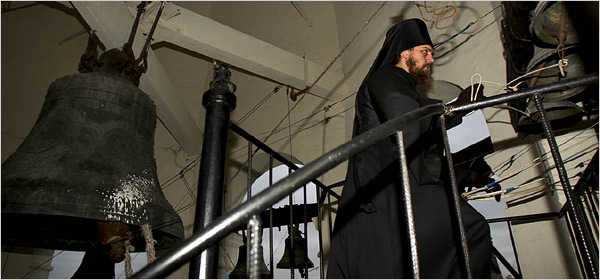
New York Times (free registration required) Sergei Kivrin March 21, 2007
At the Danilov Monastery in Moscow, Hierodeacon Roman, a bell ringer, may be able ring the tower’s original bells by next year.
MOSCOW, March 20 — The bells of Lowell House at Harvard — so much a part of the university’s tradition that they have their own society of bell ringers — will soon return to the Russian monastery from which they were sold more than 70 years ago.
The Russian Orthodox Church and the university announced a final agreement on Tuesday to move the bells next year to Danilov Monastery, the residence of the Russian patriarch, after a replacement set for Harvard is completed.
The bells have become a symbol for the resurgence of the Orthodox Church and its drive, much like Russia’s, to reclaim its former glory.
comments off Wednesday 21 Mar 2007 | Jacobse | History, Orthodox Christianity |
Asia Times Online Spengler March 13, 2007
Apropos of the debate over a European constitution, it should be remembered that Europe did not arise as an agglomeration of nations. On the contrary, Europe existed before any of its constituent nations, and the unified Europe of Church and Empire created the nations along with their languages and cultures. As individual nations, Europe’s constituent countries will die on the vine.
comments off Wednesday 14 Mar 2007 | Jacobse | Europe, History |
Catholic Family & Human Rights Institute Susan Yoshihara
(NEW YORK — C-FAM) A prominent journalist has argued recently that international political, economic and social breakdown were largely averted during the 1980’s due to the personal and political alignments between Pope John Paul II, President Ronald Reagan, and Prime Minister Margaret Thatcher. In his recently-released book, The Pope, The President, and the Prime Minister: Three Who Changed the World, National Review Editor-at-Large and Hudson Institute Fellow John O’Sullivan offers new research illuminating the three “hopeful” and “confident” personalities, and the way they forged relationships of mutual trust through their alliances and disagreements in a period of international upheaval and personal trial.
Crediting Reagan and Thatcher for reversing the economic “malaise,” stagflation, and defeatism in the American and British collective psyche, O’Sullivan chronicles the political risks both Thatcher and Reagan took to transform the world economy into a post-industrial, information-age economy that today has achieved “eighteen years of high growth with stable prices, scarcely interrupted by two mild and shallow recessions.”
Wall Street Opinion Journal Peter Nadas October 23, 2006
So, on that Tuesday afternoon, a single flow of humanity was moving down the avenues; they were coming on Váci Avenue, on Bajcsy-Zsilinszky Avenue, but on Marx Square many stopped in hesitation: Which way now? The piled-up streetcars stood motionless where they had gotten stuck in their tracks, with the lights burning in the empty compartments. There were about 80,000 people stranded around the edges of the square, on the banks of this vast intersection. They were singing, shouting demands, having visions, speechifying. A crowd, half a million strong, was already in front of the Parliament building. They demanded that the Russians go home, and clamored for Imre Nagy to make a speech.
Wall Street Opinion Journal Stefan Beck August 18, 2006
Experiencing firsthand the glamour–and backbreaking labor–of archaeology.
I’m no Marco Polo. My colleagues at work have visited Russia, Guatemala and New Zealand; I once spent a night in Paris, Ky. A trip to exotic Pittsburgh in my early college years was ruined when a hobo brandished a knife at me for telling a bad joke. Chastened by this brush with the Other, I spent my study-abroad semester writing a screenplay in New Britain, Conn. I didn’t have a passport anyway.
GREEK ORTHODOX ARCHDIOCESE OF AMERICA August 8, 2006
NEW YORK - On Wednesday, August 2, 2006, New Jersey Governor Jon Corzine signed an Assembly and Senate Joint Resolution urging the Government of Turkey to stop racial and religious discrimination, and immediately recognize the religious authority of the Ecumenical Patriarch of the Orthodox Christian Church. The State of New Jersey is the first State in the Union to pass such a Resolution, thus setting the tone for other States to follow in the renouncing of Turkey’s deplorable treatment of the Ecumenical Patriarchate and other minority religions within their country. Legislators Steve Corodemus, Upendra Chmukula, Joseph Kyrillos and Bob Smith sponsored the resolution.
comments off Tuesday 08 Aug 2006 | Jacobse | History, Orthodox Christianity |
Ed. Since we have been discussing Hiroshima and Nagasaki, here is a piece with a different point of view by an Japanese Anglican Bishop who witnessed the bomb.
FrontPageMagazine.com Mark D. Tooley August 8, 2006
The outgoing chief bishop of The Episcopal Church, having presided over that 2 million member denomination’s spiraling schism over homosexuality, squeezed time into his schedule this week for an apologetic visit to Hiroshima.
Presiding Bishop Frank Griswold expressed “repentance” over the U.S. atomic strike on the Japanese city 61 years ago. He is also very worried about current U.S. foreign and military policies, of course.
“I express my own profound sorrow, regret and repentance for the suffering the citizens of this city bore on August 6, 1945, and those in Nagasaki on August 9,” the presiding bishop told worshippers at Hiroshima’s Church of the Resurrection. “I further issue a call to continuing mutual repentance and reconciliation.”
. . . more
6 comments Tuesday 08 Aug 2006 | Jacobse | History |
Townhall.com George Will July 9, 2006
WASHINGTON — On Tuesday, July 11, the United States will become more geographically stable than it has ever been. It will have been 17,126 days since the admission of Hawaii to statehood on Aug. 21, 1959. The longest previous span between expansions of the nation was the 17,125 days between the admission of Arizona on Feb. 14, 1912, and the admission of Alaska on Jan. 3, 1959. Since then the nation has become, in a sense, smaller through the annihilation of distance and, to some extent, of difference.
Townhall.com George Will July 4, 2006
WASHINGTON — For your Fourth of July reading, open a mind-opening book about an immensely important American war concerning which you may know next to nothing. King Philip’s War, the central event in a best-seller that is one of this summer’s publishing surprises, left a lasting imprint on America.