
The Times | Tony Halpin
Last struggle is over for Nobel laureate Aleksandr Solzhenitsyn
He was the conscience of a nation whose writings exposed the horrors of the Communist Gulag and galvanised Russian opposition to the tyranny of the Soviet Union.
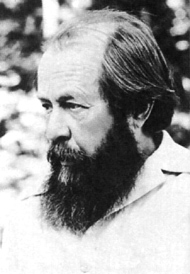
Aleksandr Solzhenitsyn’s long struggle for his beloved Russia ended last night at his home in Moscow, 14 years after he had returned in triumph from exile imposed by the Soviet regime that he had helped to bring down. His son Stepan said that the Nobel laureate had suffered heart failure, aged 89.
The former dissident had been in failing health for some years. He lived long enough to be fêted by a Kremlin that had once condemned him to slave labour. The former Russian president, Vladimir Putin, once a KGB officer, travelled to Solzhenitsyn’s home to present him with the State Prize for humanitarian achievement last year, thanking him for “all your work for the good of Russia”.
Solzhenitsyn won the Nobel Prize for Literature in 1970 after writing in harrowing detail about the system of Soviet labour camps in works such as One Day in the Life of Ivan Denisovich and The Gulag Archipelago.
A project to publish Solzhenitsyn’s complete works in his homeland for the first time was begun in 2006. The author hinted at the time that he did not expect to live to see the 30-volume project completed in 2010.
The literary celebration would have been unthinkable in 1974, when Solzhenitsyn was expelled from the Soviet Union and stripped of his citizenship soon after the first part of The Gulag Archipelago appeared in the West. The three-volume work, which took a decade to complete, forced many Western sympathisers to revise their views of the Soviet regime.
Solzhenitsyn spent eight years in labour camps for criticising Stalin in letters to a schoolfriend in 1945 after serving in the army throughout the Second World War. On his release in 1953, he was sent into internal exile in Kazakhstan, where he developed cancer. His experiences formed the basis of the novelsThe First Circleand Cancer Ward. An edited version of One Day in the Life of Ivan Denisovich was published in the Soviet Union in 1962 during the cultural thaw under Nikita Khrushchev.
The censors rejected other manuscripts, however, as the KGB placed Solzhenitsyn under increasing scrutiny for “antiSoviet” activity. His Nobel Prize for Literature was denounced as an act of political hostility, but he continued to smuggle work out to the West while underground samizdat copies circulated in Russia.
The cellist Mstislav Rostropovich protested against Solzhenitsyn’s persecution and sheltered the writer in the early 1970s. His support attracted official harassment that forced Rostropovich to flee to Paris in 1974. Solzhenitsyn moved to Germany and Switzerland after his expulsion before settling in the US in 1976. Mikhail Gorbachev restored his citizenship in 1990 and he returned to Russia in 1994, where he professed himself shocked at the impoverished condition of the people.
He was strongly critical of the new Russian society that emerged from Communism, attacking corruption and calling for a return to traditional patriotism. He was noticeably warmer about Mr Putin, however, saying that he had taken steps to “save Russia’s statehood”. In a video message recorded in response to his award from Mr Putin, Solzhenitsyn said that he hoped his work would help Russia to avoid “destructive breakdowns” in future.
Days in the life of . . .
1941 Solzhenitsyn graduates from Rostov University with a degree in mathematics, before joining the army to fight in the Second World War, achieving the rank of captain
1945 Corresponding with a friend, he makes derogatory comments about Stalin. The letters are intercepted and he is arrested
1945-53 He serves eight years in detention camps, an experience that formed the basis of his novella One Day in the Life of Ivan Denisovich
1962 Following a relaxation of censorship, the novella is published in the USSR, on the personal permission of President Krushchev. It is one of the first Russian works to criticise the Stalinist regime
1970 Awarded the Nobel Prize for Literature. Solzhenitsyn does not accept in person – fearing that he would not be let back into the USSR
1972 He smuggles out a Nobel speech describing a “Gulag Archipelago” where “it was my fate to survive, while others – perhaps with a greater gift and stronger than I – have perished”. Two years later he is expelled from the USSR
1990 With the crumbling of the old Soviet Union, Gorbachev restores Solzhenitsyn’s citizenship
1994 Solzhenitsyn returns to Russia
1998 Refuses state award from Boris Yeltsin, blaming him for the country’s ruinous economy




A great man! James K,
Here is a small excerpt from his 1978 Harvard address that hits on the core problem of legalism that we have discussed here from time to time, not just religious legalism, but legalism in general in our culture (which stems from the legalistic theology of the west IMO) Pay particular attention to the second paragraph.
Unfortunately what has happened is that we are increasily ignoring the strictures of the law and are morphing into a culture that has no legal scale, a tyranny not of governement, but a tyranny of the passions given authority by government.
May his Memory be Eternal! A great man has passed on and he will be dearly missed. He dedicated his whole life in fighting the unimaginable evil, lies, and tyranny of communism and the delusions of men who forsake God and curse His creation.
Solzhenitsyn’s courage and wisdom are still needed today as they were in past decades. The same evil and malicious ideologies he fought against still infect the world and threaten our freedom, lives, and dignity.
I am certain our Lord is welcoming him in Heaven with open arms: “Well done, good and faithful servant.”
My comment on the AOI blog:
Solzhenitsyn believed in enduring and transformative power of truth. He proved it too, when at great odds he courageously wrote the Gulags, which decimated the Marxist establishment.
So much of what he wrote is worth rereading because, like all things true, it’s true forever. One essay in particular is Live Not by Lies (originally published as Samizdat) where he chastened and exhorted fellow Russians during the great Soviet oppression:
Spiritual independence or spiritual servitude. What greater call to freedom is there?
On a personal note, I owe Solzhenitsyn a lot. When I was younger and first becoming aware of the larger world, “One Day in Life of Ivan Denisovich” had just been published in the West. I can’t say I understood what all the fuss was about, but I did understand that I needed to understand it. And so I started watching this man named Solzhenitsyn. A few years later the very first performance of the play was scheduled at the Guthrie Theater in Minneapolis. I remember cajoling my dad for the car and I went and saw it. I must have been sixteen at the time and went alone. I still remember it.
I remember too when the Harvard Address (A World Split Apart) was first published. I still have the original newspaper reprint of the speech. Again, it was like the play — I knew something here needed to be understood and in due course I might understand it.
A few years later I stumbled across the speech again at college. By that time I had figured a few things out and was astonished at the spiritual depth of Solzhenitsyn’s critique of the West — something I did not comprehend when I was younger. It led me to Orthodox Christianity.
I will always admire Alexander Solzhenitsyn for his moral courage. He stared brutal tyranny in the face and through the power of a word spoken in truth ultimately defeated it. It was not without cost. He was exiled for twenty years as punishment. Truth always exacts a price — Christians call it bearing your cross. But because Solzhenitsyn bore his, millions were freed.
May his memory be eternal.
He was a man of true courage, strengthened and emboldened by Christ to proclaim the truth, however unpopular it would be (even in the West, who lost their use for him after he criticized not only the commies, but us). The world needs more men like him.
Indeed, may his memory be eternal.
Live Not by Lies!
This speaks to all of us who compromise our integrity daily (some more than others) to earn a living. How much more does it speak to what we should demand from those who wish to lead us. As our own politics becomes increasingly ideologically driven since a shared moratlity has been jetisoned as anacronistic.
We need to reject such falsehoods from our politicians or other leaders.
All ideology is a lie. If we wish to have a free country, we must challenge our own addiction to ideology whether it be political, religious, economic or simply what we expect from our friends and families. How we treat each person with whom we interact is significant.
“Truth is not just an abstract idea, sought and known with the mind, but something personal—even a Person—sought and loved with the heart, Jesus Christ” Fr. Seraphim Rose