Zanzibar Fishermen Catch Ancient Fish
Ed. (Banescu) Another “living fossil” discovery pokes holes in the secular Macro Evolutionary theory.
AP | Ali Sultan | July 16, 2007
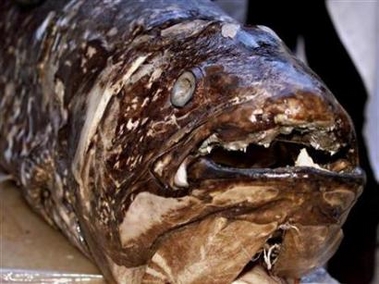
ZANZIBAR, Tanzania - Fishermen have caught a rare and endangered fish, the coelacanth, off the coast of the Indian Ocean archipelago of Zanzibar, a researcher said on Monday.
The find makes Zanzibar the third place in Tanzania where fishermen have caught the coelacanth, a heavy-bodied, many-finned fish with a three-lobed tail that was thought extinct until it was caught in 1938 off the coast of South Africa. Since then two types of coelacanth have been caught in five other countries: Comoros, Indonesia, Kenya, Madagascar and Mozambique, according to African Coelacanth Ecosystem Program.
“Fishermen informed us that they caught a strange fish in their nets. We rushed to Nungwi (the northern reaches of Zanzibar) to find it’s a coelacanth, a rare fish thought to have become extinct when it disappeared from fossil records 80 million years ago,” said Nariman Jiddawi of the Institute of Marine Sciences, which is part of the University of Dar es Salaam in Tanzania’s commercial capital.
. . . more
Monday 16 Jul 2007 | Blog-Editor | Intelligent design |

Sure is an ugly looking fish.
If a living thing, especially one that lived in water (the “craddle” of life), is capable of surviving in a flawless form for 360 million years, having undergone very little or no change then this presents the Macro Evolutionists with strong evidence that seriously challenges the gradual evolution model that supposedly turns simple organisms into progressively complex ones.
Furthemore, this latest “living fossil” fish is far from being the only example to demonstrate this. There are many other plants and animals, including the mighty cockroach, lice, and the Horseshoe Crab, that exhibit no differences from their original states, that first appeared millions or even hundreds of millions of years ago.
Here’s a link that includes just a small sampling of the various living fossils out there: http://www.newcreationism.org/Living_Fossils.html
Fr., he was so ugly that nothing else wanted to eat him
Re #1 and #3
The ugliness might explain this guy’s survival but it makes the reproduction part even more of a mystery.
Coelancanth couples always travel together, that way they don’t have to kiss each other goodbye
Chris has a link to http://www.dinofish.com/
If you click on biology & behaviour you will see a newborn coelacanth pup — isn’t he cute
Chris B - The exception does not disprove the rule, and this species does not challenge the theory of evolution.
The Coelancanth may have resided in an environment, deep ocean, where evolution occurred early on and later rare random mutations did not confer a significant enough advantage for an even newer form of the species to replace the older form. The fact that strains of viruses immune to antibiotics continue to evolve, for example, mean that Darwin’s theory of natural selection is alive and well.
To Dean:
I cannot discuss very much about Science things, but based on what you have just written, I am wondering. Would you timetravel with me back to an Orthodox Education Class I was once in, because I am interested in your take on what I heard.
First, briefly — this is how we arrived there. We responded to a call. Which was written on the masthead of AGAIN magazine (in the old days.) “A Call for the people of God to return to their roots in Orthodoxy once AGAIN.”
We got pretty far, we became chrismated, and then one day we are in this class. My toddler is on my lap when the Provost of the [state name withheld] University Medical School states that: ” [man] has descended from apes.” The priest gave this comment a pass.
What do you say?
Dean, I was not aware the Macro Evolution is supposed to “pause” in deep water! Also, notice I clearly stated MACRO Evolutionary theory, not Micro Evolutionary fact. I am well aware of and agree that Micro Evolution, otherwise known as adaptation to one’s environment, has been shown to occur and does happen with regularity in all organisms.
Talking about minor adjustments and “evolution” within a microorganism and within a species (ie: the acient shark, vs. modern shark, still a shark except smaller with slight variations in shape, etc.. but it did not turn into a dolphin or giraffe…) and extrapolating that into Macro Evolutionary proof is dishonest and a completely false analogy. Huge difference between viruses and bacteria developing resistance to drugs, and carbon and hyrdrogen atoms forming cells, who then turned into ameobas, who eventually turned into frogs given enough time.
Dean and Nancy L.
St. Athanasius: “In regard to the making of the universe and the creation of all things there have been various opinions, and each person has propounded the theory that suited his own taste. For instance, some say that all things are self-originated and, so to speak, haphazard. The Epicureans are among these; they deny that there is any Mind behind the universe at all. This view is contrary to all the facts of experience, their own existence included”
The philosophical naturalism underlying macro-evolution is not modern or new, it is pagan and quite ancient.
Dean, you cannot be Epicurean and Christian. You cannot be Marxist and Christian. You cannot subscribe to any type of determinism and be Christian.
Theistic evolution is no better as it is essentially a combination of neo-Platonism and Deism.
Every single one of the arugments against the Christian understanding on the matters disscussed here recently from homosexuality to euthanasia to this come from a place of denying the existence of the human being as created in the image and likeness of God. They come from a place that accepts the shattered, fallen image as “natural” and only want to shatter the image further out of pride, slavery to the passions and malice.
Nancy - I firmly believe, as we recite in the Creed, the God is the Creator of all things visible and invisible. However, this does not mean that evolution could not have been part of God’s plan or process. It’s possible that God’s intervention in our creation may have occurred before the apearance of our species on earth.
Francis Collins, the scientist who lead the Human Genome Project and an evangelical Christian writes:
http://www.salon.com/books/int/2006/08/07/collins/index.html
As Orthodox Christian’s we also believe that God is beyond all human understanding and comprehension. It is enough for us to know that God is the radiant core of all the goodness and love in the universe and that He gave his only begotten son so that we could attain salvation.
It is unneccesary, and frankly a bit ridiculous, to suggest that our faith in God depends on us believing that Adam and Eve rode around the Garden of Eden on the backs of dinosaurs like some fundementalists believe.
Michael,
Excellent point! That’s precisely what this is. C.S. Lewis in his essay “The Funeral of a Great Myth” said it quite eloquently:
Dean, if I may summarize what is communitcated to me from your post. Belief has no consequence in the “real world”. There is no way to know what God is really like and by extension what we are really like so we have to rely on empiricism and rationalism. Anyone one who believes otherwise is a closet fundamentalist since there is no explanation except the physical anyway.
The fact that the path you suggest leads to the denial of the teaching and experience of the Church is a matter of no consequence since it is only a comforting belief anyway.
You’re just like Jim, but at least he has some excuse. You have none.
Let me go over it again.
Marco-evolution stems from pagan materialism philosophically since it is founded on the assumption that matter is self-existent and self-organizing. One cannot accept such ideas and remain a Christian.
Theistic evolution is a vain attempt to have your cake and eat it too–to serve two masters. It is neo-Platonic and Deist in content and therefore incompatible with the teachings of the Church. Ultimately theistic evoloution is a denial of both the neccessity for and the reality of the Incarnation (the means of our salvation).
Sorry, Dean but you are once again wholly and compeltely wrong. It is instructive to me that in most of your posts you do not appeal to Orthodox sources at all, everything else but. It does not appear that you reach to the Church for understanding and sustenance.
Michael: If I may refer to the Divine Liturgy of St. John Crysostom, an impeccable Orthodox source:
http://www.ocf.org/OrthodoxPage/liturgy/liturgy.html
How do you interpret “ineffable, beyond comprehension, invisible, beyond understanding”?
I interpret it to mean that there are details of God’s nature and existence that are beyond our understanding and that it is futile and unnecessary to even try and understand. Into this “futile and unneccesary” category i would put the exact method God used to create the world. We don’t need to know how God created the universe, just that he did.
We don’t need to know how God created the universe, just that he did.
But I thought you said:
“It’s possible that God’s intervention in our creation may have occurred before the apearance of our species on earth.”
And then go on to affirm evolution as the origin of man
Which is it?
Clarification is in order: Our faith does not depend on knowing exactly how God created the universe, just that He did.
Actually, this is not quite true. You see, the manner in which something is created is related to what that something is. Would you say Dean, that art is wholly separate from it’s creator? Something beautiful (say, a painting or a statue) is separate from who created it, and how he created it?
Even materialist recognize this, when they look at a beautiful mountain scene or a sublime rock formation in a cavern, they express “wonder” and “awe” at the “blind forces” that created it - why is that? Thus, they see a beauty in the creation that is itself reflective of the beauty of the creator (in this case a material, “blind” creator).
Also…
We know allot about how the creation was created, and how it fell, and how it will be redeemed. This information is in basic conflict with a neo-epicurean (see Michael’s quote of St. Athanasius above) account.
If the two are in conflict, how do you resolve it?
Dean,
That’s true. However, just as we rely on our God-given reason, intelligence, and inquisite nature to reverse engineer God’s creation, we need to make sure that the laws and scientific principles we do discover are indeed correct and accurately and consistently reveal the hand of the Creator. We apply stringent parameters in physics, chemistry, engineering, astronomy, and other scientific areas of study. We require solid proof and repeatable experiments to verify and confirm any theory that seeks “law” status.
Unfortunately, the Macro Evolutionary “scientists” are flauting those standards by using the data and experiments which only conclusively and scientifically show adaptation to the environment (Micro Evolution) as existing in organisms at all levels of existence and across millions of years, and claiming that it proves Macro Evolution. Yet, very few of their peers bother to hold them accountable. If these folks want to gain credibility and insist their “theory” is “law”, they have a very long way to go. Unfortunately, our secular culture and most of the scientific community continues obfuscate the issues by referring to (Macro) Evolution as fact, in effect perpetuating a fraud. I don’t know about you but I certainly don’t like being lied to, and I’m certainly not going to trust pseudo-scientists who pick and chose their data and fill in the gaps in their theories with wishful thinking, avoidance of contrary evidence, and demonization of critics rather than relying on objective data and verifiable experiments.
Mr. Banescu says:
“Dean,
Clarification is in order: Our faith does not depend on knowing exactly how God created the universe, just that He did.
That’s true.”
I do not believe this statement of Dean’s to be true. Putting aside the “exactly” for a moment, how something is created is organically related to the why, when, what, and most importantly, by whom. Something created personally, can not at the same time be created impersonally. This is where Dean/materialists do not understand the implications of Epicurean philosophy and metaphysics. You can not add “persona”, to “impersonal”, and get “Christian evolution”. Christian evolutionism is a contradiction. Like Chesterton said, God my transcend logic, but he never simply breaks it (paraphrasing here).
The rest of your post stands on its own…
Dean, the main point of my post was not the use (in your most recent post, misuse of Orthodox sources). It is the fundamental divide between the philosophical materialism (neo-Epicurianism) that is the foundation for evolutionary biology and traditional Christianity.
One cannot be a Christian, especially an Orthdox one and accept that matter is self-existent and self-organizing. Once the assumption that matter is self-existent and self-organizing is abandoned, the entire structure of the neo-Epicurian macro-evolutionists belief collapses.
Let me remind you, God is Incarnate. “Submit yourself all ye nations, for God is with us!” The oxymoron “theistic evolution” ultimately denies the fact that our Lord did not shuck off our human nature upon Ascension. He is still fully human and fully divine therefore intimately involved in His creation. Our salvation and the healing of the rest of creation is dependent upon that. You would not have been able to receive the “Seal of the Gift of the Holy Spirit” and even be in the Church otherwise.
Icons that are not created in accord with canonical rules are not to be used by the faithful or the Church. The how is just as important as the why and the what.
God says, “Let there be….” and it is. Our being is contingent only upon His Word, not on anything else in creation. So it is for every other thing, even the rocks. We, however, are the only creation into which He breathed a living soul and formed in His image and likeness. To assert that we “descended from the apes” is simply not Christian.
St. Gregory of Palamas in the 14th century rather nicely put to bed, for Orthodox, the fallacy that God cannot be reached, but only thought about (which your misuse of the quote from the Divine Liturgy implies when left to stand alone and out of context). God is wholly other and wholly unknowable in His essence, yet He reveals Himself to us in His energies which are uncreated. That is why we can have a deep, intimate, communion with the unknowable God that is real and personal. In case you’ve forgotten, the Divine Liturgy is all about creating a link between the known and the unknown, the seen and the unseen, the created and the uncreated that allows us to step into His Kingdom and be with Our Lord, God, and Savior. It is real, that is why the saints warn us to approach the Cup with reverance, humility, and repentance lest we eat and drink damnation to ourselves.
You have immersed yourself in western dichotomies to such and extent you fail to grasp the antinomical nature of the Orthodox, so forget what I said, go back to using western sources and apply yourself to the heart of my post, not the window dressing.
Note 20. Michael writes:
Most people think that random evolution means the physical laws that guided the self-organization of matter preexisted that self-organization. But if this were true then order, and not randomness, was already at work in the universe.
If the universe was completely random however, then the laws must have emerged out of the matter, and not the other way around. The only way to avoid this contradiction is by positing a big bang, which is to say we don’t really know how the universe began.
I’m fine with the unknowing. I think it is a mystery that may never be explained.
What then about Genesis? The key to Genesis is revealed when comparing it to the other creation narratives that exist — including evolution. (I think that Darwinian evolution is the creation story of philosophical materialism.) When we compare Genesis to the others, we discover that in creating the world by speaking it into existence, God is revealed as existing outside of space and time. This is a remarkable insight the Hebrews gave the world for up to that time, God was a captive of His creation, and thus there was no ontological distance between Creator and created. This is what I meant in an earlier thread that at the first prophetic utterance, paganism was doomed.
Genesis reveals not the origin of the world, but man’s place within it. And he can only understand his place within it by referencing God. If God is captive within the creation, then He is also the author of its brokenness and, ultimately, of evil. That’s one reason why the pagan deities were so capricious, even brutal.
Evolution of course posits no God — only energy, so the cultural ramifications of that creation story will differ from the pagan experience.
I wrote a review on a book that employed that premise: From Darwin to Hitler: Evolutionary ethics, eugenics, and racism in Germany. Richard Wiekert, the author of the book, took a lot of flak for his thesis that the adoption of the evolutionary paradigm to social reorganization contributed to the rise of Hitler. But it makes sense. If creation narratives exert such influence in a culture (historically this point is indisputable), why would Darwinian evolution be any different?
Is all materialism pagan, or is there a particular quality that distinguishes “pagan materialism?”
Well yes, in that all materialism I have encountered (besides the most crude, sophmoric kind, which is unreasoned and unexamined) is neo-Epicurean, and not really much “neo” to it…
http://en.wikipedia.org/wiki/Epicureanism
Do materialists choose to be Epicurean, or is this a label you apply to them?
It seems like a lot of jargon to describe a significant percentage of all the research scientists in the world; I’m not certain how many consider themselves to be “neo-Epicureans.”
Note 10. You cannot subscribe to any type of determinism and be Christian.
Michael, would you elaborate “any type of determinism?” What does it reference?
Nancy,
There are several types of determinism: genetic, economic, spiritual. The basic premise for each of them is that some outside force determines the course of individual human life: our genes, economics/social status, or even God. Dean’s favorite is economic determinism, a.k.a. Marxism. My biggest gripe with Calvinism and its derivatives is its spiritual determinism.
Genetic determinism comes into play as part of the push for normalizing homosexuality—it’s in the genes, or the really good one: God made me this way it must be OK.
Among other problems determinism of all types ignores sin, the fall and excludes any possibility for salvation as the Church has always taught salvation: a free, unmerited gift of God’s grace, freely accepted. Since there is no freedom in deterministic philosophies, when they are expressed politically, tyranny is the result.
Evolutionary biology is deterministic on a grand scale. Not only is there no choice, there is no meaning in life, everything is simply determined by the “forces of nature”.
Phil, ideas have consequences, they never go away. It is simply a short hand to describing the content of their ideas and the fact that they are not modern, simply a more sophisticated version of an old fallacy. Since many of scientists are educated, it would surprise me if they were not at some level aware of the Epicurean content of their beliefs. I would be equally surprised if they applied them consciously. They have accepted a mind-set within which they work.
I’ve been studying the history of ideas all of my adult life. It is one of the things that led me to Christianity and eventually the Church.
Not to split hairs on your definition of determinism, Michael, but spiritual determinism does not reject salvation as an unmerited gift. In fact, it emphatically asserts that it is. What it does reject is the idea that man can freely choose to accept or reject it. In this view, man has no capability or internal resource to choose good. He must be “born again” from above, an event that occurs in a moment without any initiative or desire on the part of the recipient, and often occurring against the recipient’s own will.
Though believers in this will deny that man is “not free” to choose evil, they simultaneously insist that man is born as a slave to a force he has no power to reject and from which he cannot even desire to escape. Further, though God must rescue them from this state, He only desires that a relative few will do so.
Many will find this a sort of cosmic tyranny, but those attached to such doctrines will flatly insist that any such label is a blasphemous denial of the goodness of a sovereign God who’s “ways are past understanding”.
James, you are once again splitting into parts what is a unity.
It is not a gift if one is forced to receive it. God is either a loving, kneotic giver or a vengeful, sadistic tryannt. Spiritual determinism whether it is called Christian or Muslim is an abomination. I’ll reiterate that spiritual determinism precludes the possibility of salvation as the Church teaches it.
Many people recognize the poison of spiritual determinism and end up rejecting Christ because of it. A good part of the vengefulness expressed from time to time on this blog comes from people thinking that we Orthodox hold to the same views as the majority of western Christianity (either legalistic or deterministic or irrational pietists). We are none of those.
James you say,
You are accurate in your statement. Unfortunately, such belief denies the Incarnation and the salvation created by it. It is, (in my probably arrogant opinion IMAO) essentially mono-paganism
That being said there are a number of such people who actually love Jesus Christ and that will cover a lot as far as they personally are concerned.
Notes 29-30: I didn’t say I believe what I wrote, I was just stating what others have clarified for me. And sure, I have no reason to suggest that they’re “not Christian” because they hold some repugnant ideas (at least repugnant to many).
It’d be nice if they’d return the favor, however, since apparently being Orthodox (or Catholic) implies one isn’t a “True Christian”. For all this stuff about “believing in Jesus” being all one has to do, there’s really a rather large list of theological extras one has to accept (or not accept). Otherwise, you’re discarded rather quickly.
James, I realize you are not a proponent. The attitude you refer to is perfectly consistent with their theology.
Do materialists choose to be Epicurean, or is this a label you apply to them?
It is an accurate description of many peoples worldview/philosophy/faith. Just like “Christian”, or “Buddhist”
It seems like a lot of jargon to describe a significant percentage of all the research scientists in the world; I’m not certain how many consider themselves to be “neo-Epicureans.”
The half dozen of so folks whom I have known that could be described as “research scientists” were mix of Christians, theists, and neo-Epicureans.
Note 10.
It is unneccesary, and frankly a bit ridiculous, to suggest that our faith in God depends on us believing that Adam and Eve rode around the Garden of Eden on the backs of dinosaurs like some fundementalists believe.
Hi Dean,
Those are children at a neat park in Pensacola riding dinosaurs —
not that Adam and Eve necessarily did so. I believe the dinosaurs, being land animals were created on Day Six, the same day as Adam and Eve because this is what Moses was given by God to record for your benefit. They were plant eaters as were Adam and Eve, no meat. There was no killing/dying until after the Fall. More than likely, the fossil record of dinosaurs came about during the Great Flood - Noah. Dinosaurs survived by being taken on the ark. This is what the Bible says. (Stories of dragons …)
You can read a little about the Coelacanth in Seraphim Rose’s Genesis Creation and Early Man, page 306, footnote. This fish was to have lived 70 million years ago, and become extinct the same time as dinosaurs.
I also read the interview with Francis Collins you provided. In his case, evangelical seems to mean he believes in the Virgin Birth, the Trinity, the deity of Christ, Resurrection and things “miraculous.” Miraculous Six days? Statements in order? Never, for a theistic evolutionist.
Here I quote, “In his studies, Fr Seraphim appreciated the work of the scientific creationists, a group of Protestant Christians who were also professional scientists. The creation science movement had been catalyzed in America with the publication of the seminal textbook The Genesis Flood, by Dr Henry Morris, Dr John Whitcomb.”
Dean, I am compelled to defend against something if I may. You say: “frankly a bit ridiculous, to suggest our faith depends….” But, our faith depends upon whether the scriptures are true. Youths go to the University to be told the Bible is wrong because Genesis is “so wrong.”
If Genesis is ’so wrong’, then do you blame them for struggling mightily over whether the Scriptures are fables? Genesis 3:15 Jesus as Saviour is promised. Would you mind if I asked you this: If Genesis is ’so wrong’ — how can a youth, or even youself, truly respect the Bible as the Word of God?
Nancy - Thank you for reading the Francis Collins interview, even if you didn’t agree with it. He provides the persepective of a very respected scientist who is also a very sincere Christian trying to reconcile what others see as opposing “truths”.
However you accused people who do not believe that every word in the Bible is literal, of being less than true Christians, but rather “theistic evolutionists” and I believe that is a very serious, very wrong and inflammatory thing to do, deserving of a response.
First, did you see where Dr. Collins was asked “Obviously, you’re saying you should not read the Bible literally, especially the story of Genesis.”, and he responded:
Like Dr. Collins, I don’t believe we have to reject science in order to believe in God. When you drive your car across a bridge, you are not travelling across a magic concrete and steel span being held aloft by angels, but on a structure built following certain scientific egnineering and mathematical principles. When you take an antibiotic to relieve an infection the little pill isn’t full of solidified holy water, but chemical gents found by scientific research in biology and organic chemistry to help your body eliminate viruses and foreign organisms. The Geology that tells us the earth is millions of years old is based ion the same scientifc methods.
That is not to say there are no such things as miracles; but that God’s miracles and science coexist. Two summers ago, my mother was suffering from macular degeneration, her Priest recited the prayer for health for her in Church, and the very next week the FDA approved the drug that eventually restored her eyesight. Was it science or God? I would like to think both.
The stories of the early Old Testament can be seen as allegories that contain important “truths”, even if every word is not literally “true”. Look at the audience that Genesis was written for - illiterate, nomadic, desert wanderers. Is there any way that they could even begin to understand a scientific explanation of the origins of the universe, the earth and all its flora and fauna? Of course the stories had to be allegorical.
The Old Testament tells us a lot of other things that we cannot accept, literally or figuratively - that people should be stoned to death for eating shellfish or other offenses, or that a loving God wanted the Israelites to attack villages of the Caananites and slaughter their people, every man, woman and child.
The value in the Old Testament comes from the allegories that help us understand humanity’s relationship to God, from the Ten Commndments and the books of the Prophets, the Jeremiads that warn Israel to repent, and in doing so, set forth humanity’s first moral and ethical guidelines, and in the first intimations and foreshadowings of the coming of Christ, the Messiah. That is what I think we need focus on in the Old Testament, not whether the world was made in six days or six million years.
Dean, once again your false dicotomies lead to false conclusions. You oppose what you call a “literal” reading of Genesis with modern science.
God either created out of nothing and is in His Creation (the Orthodox Christian view) or He did not. I tell you once again, you cannot accept a materialist or Deist interpretation and really be Orthodox. Theistic evoloution posits a God who is removed from His creation. If that is what you really believe, then nothing in the Orthodox Church can possibly have any reality for you. If your continued presence in the Church is only from cultural apathy, I suggest you are missing the point.
The Old Testament was written for us, for humanity, for Christians. You are just as ignorant of God, perhaps more so, as those “poor illiterate peasants” whom you look down on so easily.
You easily and blythly reject so much of the faith for which your forbearers suffered and died. Why, because they were illiterate peasants as many of them surely were? And today with all of our “modern” knowledge we are so superior?
Shame on you!
Michael - Show me where the Nicene Creed, our Orthodox testament of faith, requires a literal reading of the Old Testament. In fact show me how one thing I have said on this subject contradicts the Nicene Creed.
I’ve said over and over and over again the God created the universe, “heaven and earth, and all things visible and invisible”. I believe that. Why is that not enough for you?
Note 35. Dean writes:
There is no such thing as “literally true” and this includes the literalism of history and science. IOW, the veracity of the scriptures does not rest in historicism or in science but for different reasons.
History is literature. What remains of an historical event IOW, is the text recounting the event. Historians know this which is why you have Marxist historians, classical historians, etc. Historiography is necessarily interpretive, that is, events are portrayed through the words of the historian.
Science, on the other hand, when it posits suppositions about origins, reaches far beyond its expertise and assumes the role that only literature can fulfill. Darwin’s hypothesis about the origins of man and the universe is just such an overreaching. Darwin’s hypothesis actually functions as a story; the story provides the framework by which the data is arranged. The evolutionary theory in other words is not the result of investigation, but the framework within which the investigation takes place. In the last one hundred years the evidence is proving scant, which is to say that the story guiding the investigation does not hold together.
So the scriptures are not “true” because they are (conform to) history or science. Rather, their veracity must rest elsewhere. Searching the scriptures we find that veracity lies in the authority of the prophet and apostle, that is, the ones through whom the accounts were given. The prophet and apostle made an audacious claim: their word came from God. The final ground of authority, then, rests in God. (Like I said, it’s an audacious claim.)
This is hard for a modern to hear, conditioned as he is to the notion that historical or scientific facts don’t reference a larger framework of assumptions — a story — that arrange the facts in a larger constellation of ideas that gives the facts their meaning. Put another way, the notion that a story does not exist and is not needed is the modern story.
You see this in the evolutionary hypothesis most clearly, especially when the hypothesis reaches into the larger culture, say, in Marxism or feminism, or any other story that posits the ground of meaning as material — matter — instead of a word. There is no voice in a material universe, only operations, collisions of molecules and atoms, processes, etc. that inevitably leads one down the road the Existentialists followed early in the last century (when the memory of Christian culture was still influential), to the nihilism of the present age (see: Awakening from Nihilism: The Templeton Prize Address).
These nomadic wanderers, then, were not as ignorant as we might think. They understood something about the universe that is lost today, despite their uninformed cosmologies, or superstitions. Why do you think the shepherds were the first ones informed of the birth of the King of Creation?
The Apostle Paul certainly understood this. If the world is created by a Word (the Word spoke the universe into existence), and if Light penetrates the darkness through a word, then we might grasp how powerful the Gospel really is. The veracity of the Gospel in other words, does not rest in historicity or science but in the fact it proceeds from the mouth of God and, when preached and heard, reveals Christ — the One by whom the world was created and though whom all things consist and have their being.
Dean, Fr. Hans says it better, but since you asked me and I’m arrogant enought to think that I actually have something to say, here we go: what do you mean by literal? If you mean by literal that God expressly created out of nothing and invested Himself in His Creation in a special way through us intially and later in the Incarnation Himself, then everything about the Orthdox Church requires that we read it that way.
If you think that “metaphocial” within the Orthodox Tradition means a way of harmonizing the Scripture with the mind of world, you are absoultely mistaken.
There is an entire book “Genesis, Creation and Early Man” which attempts to provide an answer to your question.
The philosophy that informs and drives macro-evolution denies what you qoute from the Creed. It requires the self-organization of matter. At least you can see that, can’t you? So any postulate that requires one species to change into another up to and including human beings is obviously not in accord with the techaings of the Church, right?
The idea of “theistic evolotion” accepts that and postulates further that God set things in motion and the rest is carried out in accordance with his natural laws, the Divine Clockmaker of Deisim (a heresy to Orthodox). That denies several things that are in the Creed that are the warp and woof of Orthodox Christianity, especially the Fall and its effects on all of Creation, not just upon us. Theistic evoloution denies the essential fact of man created as steward of creation.
It pretty explicitly denies the Incarnation, unless you want to say that the Incarnation was only spiritual in effect which is a heretical notion. Theistic evoloution also denies the theology of St. Maximus the Confessor and the cosmology expressed by St. Paul, espeically in Romans 1.
If the teleology inherent in “theistic evoloution” was true, Chardin (a proven fraud artist and an express heretic) would be a saint and there would be no need for our Lord to Incarnate. Actually, it seems to me that you would be quite comfortable with his philosophy unfortuantely.
Now, if you feel that that is a better explanation of the reality of things, great Dean. It just means that everything the Church teaches, and affirms is a lie.
“Theistic evolution” is simply an attempt to harmonize Christianity with philosophical naturalism because those who say they believe in it are either too lazy or too cowardly to stand for the truth of the Chrisitan revelation or have simply ceased to believe in the first place.
Everything you post here that I have read shows a reliance on worldly philosophies over that of the Church. Again, if you feel those philosophies provide a better explanation of who we are and how we are supposed to act, that’s peachy. Just don’t claim to be Orthdox at the same time. Have the intellectual and spiritual honesty to declare what you really believe. It cannot be both.
How can a two dimensional idea expicitly created to avoid the need for God be good enough for you?
Evolution sees death as the engine of progress. Christianity sees death as an enemy to be destroyed. The two views are not compatible.
Note 39. Michael writes:
Another possibility is that they do not understand philosophical naturalism or Christianity even though they think they do.
Yes, death. For Christians, death is not a natural part of creation it is a result of the ontological separation between man, the steward, and the Creator. That is why creation goans and travails until the advent of the Lord.
How one can sing the Pascha Homily and hold to the idea of evolution is beyond me. The only way to do it honestly is compartmentalization. God over here–science over there. Rationalization to avoid conflict.
Is that what you are doing Dean, rationalizing the obvious conflicts between the ideology that informs so many of your posts and the teaching of the Church?
Just remember Dean, science, philosophy, and politics are tools. They do not, are not not meant to, provide answers–only more questions. They are all creations of man’s mind and intellect. As such they can be and are used for good or evil (there’s that nasty fallen state again). Since our capacity for rationalisation is almost infinite, our excuses not to follow God, not to use our intellect in His service, are nearly the same.
There is only one way to the Father. Everything else is vanity.
Michael writes: “God either created out of nothing and is in His Creation (the Orthodox Christian view) or He did not. I tell you once again, you cannot accept a materialist or Deist interpretation and really be Orthodox. Theistic evolution posits a God who is removed from His creation.”
So what does that imply for the age of the earth? Would you say that, in accordance with the book of Genesis, that the earth is around 6,000 years old? If not, how old do you think it is, and when did life appear? I’m just wondering what your timeline is.
Don’t have one, don’t need one. It is what it is.
Just remember that time, like what we recognize as the material world was totally different prior to the fall. Then there is the fact of the Incarnation. No telling what that did to the non-human part of creation.
Thank you for reading the Francis Collins interview, even if you didn’t agree with it. He provides the persepective of a very respected scientist who is also a very sincere Christian trying to reconcile what others see as opposing “truths”.
Hi Dean,
This is what I think to myself, “that may be.” Concerning “very sincere Christian.” Collins became a Christian after his foundational education was framed. So, it’s an understatement, he’s dealing with tons when he brings his entire lifework [identity iyw] to attempt to place it All under the Light of Sacred Scripture, and even further as Seraphim Rose has shown - re: Genesis, also under the Light of Patristic Writing.
However you accused people who do not believe that every word in the Bible is literal, of being less than true Christians, but rather “theistic evolutionists” and I believe that is a very serious, very wrong and inflammatory thing to do, deserving of a response.
Deny the sentence.
Dean, as you say those words are inflammatory. But I wish to point out you Interpolate into my own, in fact quite Peppered. Those words are not mine: I don’t like the whole sentence. So, if we could stay on task, so to speak and we will both leave off inflamation. No problem.
First, did you see where Dr. Collins was asked “Obviously, you’re saying you should not read the Bible literally, especially the story of Genesis.”, and he responded:
Dr Collins and Dean,
There is something else that threatens, which is not brought up by the interviewer.
But First. You say in essence, ‘believers are threatened when you start watering down any part of the Bible.’ We should come to an agreement: no “sincere Christian” will tolerate Watering Down the Bible, this is a Basic Given. What does ‘watering down’ mean? Diluting, messing with the text as it stands, whatever does not take the text as God-breathed - this dilutes. What was meant to ‘multiply faith & grace’ to our heart is set on the sideline, and therefore does no such thing. The scriptures are Exquisitely put together down to jot and tittle. This must be a given, or we can’t communicate (you & I, I mean) effectively. I do not think that only certain sects of Christians should be known for this high view of God’s Word.
So — What else threatens? Testing one’s inherited atheistic/evolutionist window on the world. God deliberately hides ‘his wisdom’ from the sincerely intelligent, but he gives it to the seeking, his own. And I believe he causes “his own” to seek, so there is no glory that can be ascribed to man or woman for being a “good seeker.” Or, a “good finder. All glory to God.
We were to a Russian Church this morning (out of town.) I don’t know if the text was also yours:
So, at any rate Dean, I believe I am free to apply St Paul’s appeal to this ragged disparity of views on Genesis. I think we should come to agree? What is the meat of the potato, for use of a strange phrase?
What if we tried to arrive at a one small unity concerning Genesis Seven.
Just two verses. I would like to know what you think this Biblical Text might possibly mean, in your Book? If it doesn’t mean what is meant by a normal understanding of words by one with a perhaps eighth grade education. And I believe the people closer to the time of Eden were actually *more* intelligent — if anything — than are we now. It took the *most* clever of deceivers to turn Adam/Eve around.
Another thing: How smart would *you* be if you lived to be 600 years?
Here’s Genesis Seven, 2 verses:
What does Francis Collins, who believes in the Virgin Birth! of all things, in the Holy Trinity! [whom St Basil stated that along with this doctirne was not given the gift of Arithmetic
] and by the by, the Deists of former days mocked rather than simply accept —- what does Francis Collins take this “troubling passage” in Genesis Seven to mean?
1. All the fountains of the Great Deep were broken up?
2. All the Windows of Heaven were opened?
3. Rain on the earth for 40 days and 40 nights?
Michael writes: “Just remember that time, like what we recognize as the material world was totally different prior to the fall.”
Ok, let me ask a different question. How long ago did the fall occur? Presumably time and the material world after the fall are pretty much the same as they are today, so it must be possible to estimate when the fall happened, right?
When you say that time and the material world were different before the fall, I guess I’m wondering if there is some way that you’re determining that, or if it’s simply an assumption that they must have been different, or else the book of Genesis wouldn’t make any kind of historical sense.
Jim, Note 48, why are you bothering with this?
Jim, Note 48, just seems like some kind of taunting rather than any kind of intelligent discussion.
There is no way that anybody has an answer to that question. Some things we just don’t know and may never know.
Whenever you address issues directly related to religion you reveal a kind of two-dimensional mind-set. God is the third dimension and you can’t begin to understand His influence if you are thinking two-dimensionally. Please note I don’t pretend to “understand God’s influence.” What tiny glimmer I have comes many from Scripture and the rest from life experience.
Missourian writes: “Jim, Note 48, just seems like some kind of taunting rather than any kind of intelligent discussion.”
I’m just asking questions. As this point I’m trying to understand what is being asserted, and what the implications are.
Dean was being taken to task for certain beliefs about evolution, up to and including ” . . . if you feel that that is a better explanation of the reality of things . . . It just means that everything the Church teaches, and affirms is a lie.”
So people are talking about serious things here. I ask Michael, what’s the timeline, how do you think things went down. He replied, I don’t have a timeline, but time and matter were different before the Fall.
So what does that mean? How were they different? Time was slower? Faster? Non-existent? The material world was — what? Bigger? Brighter? Made of different elements?
Missourian: “There is no way that anybody has an answer to that question. Some things we just don’t know and may never know.”
If no one knows how life originated, how old the universe is, how time and matter were different before the fall, etc., then how does anyone know that Dean is wrong?
Missourian: ‘Whenever you address issues directly related to religion you reveal a kind of two-dimensional mind-set. God is the third dimension and you can’t begin to understand His influence if you are thinking two-dimensionally. Please note I don’t pretend to “understand God’s influence.” What tiny glimmer I have comes many from Scripture and the rest from life experience.”
But just because we use the word “God” in connection with an issue, doesn’t mean that the implausible suddenly becomes plausible. Using the word “God” doesn’t automatically set one free from having to deal with the implications of one’s belief.
I don’t want to taunt anyone or make fun of anyone’s belief. But at the same time, I don’t think that religious beliefs should be given an automatic pass merely because they are religious. You know, when someone utters a religious belief there’s this kind of hush that falls across the room, and it is considered rude to question the belief because . . . well, because it’s a religious belief. I don’t buy that.
The larger issue here is not really about religious belief, but about the role that scientific knowledge should have in forming our beliefs about the world. If the biological and physical sciences are irrelevant to our understanding of those issues — if everything we need is in the first two pages of Genesis — then why bother with paleontology, geology, astronomy, biochemistry, genetics, and every other relevant field? Why build a Hubble space telescope that peers “millions” of light years into the universe, if the universe is only slightly older than the Sphinx?
Discussions about origins of the earth and life are usually doomed from the start because the terms are not defined up front. As a result, people end up talking past each other endlessly. So, why doesn’t everyone take a stab at defining these terms:
evolution
common descent
darwinism
theistic evolution
theistic darwinism
My bet is that everyone involved in this thread has different meanings attached to each of these terms
Jim, Note 50, how could you not understand after all this time
Dean describes himself as an Orthodox Christian. Michael was responding to Dean in the context of the teachings of the Orthodox Church. Michael considered Dean’s positions to be inconsistent with the teachings of the Orthodox Church. Since, Dean, asserts that he is an Orthodox Christian, Michael may have a point.
Jim, after all this time, how could you not understand this aspect of Michael’s comment? Really, Jim, we are talking about a matter of years now.
This raises another point, debating with you is like writing on water. The same point is explained over and over and over again. You don’t really respond with a counter-argument you just adopt the now, very tiresome pose of “I’m just asking questions.” Questions which the writer answered. After the answers are supplied, it is appropriate for you to address the answers, which you rarely do.
Jim, Note 50, straw man argument and non-acknowledged underlying assumptions
This is a straw man argument.Many authors have noted that Christian religious belief is held up to ridicule and scorn in America with great regularity. The ACLU has devoted millions of dollars and millions of manhours to pushing Christianity out of the public sphere. To assert that religion is held sacred as a matter of course is simply inaccurate in America. Strawman number one.
You believe you have a clear idea of what is “plausible.” It is very clear to you. You believe you are challenging the “implausible.”
What you are not stating is how do you decide what is “plausible.” In general, atheists begin with the unchallenged and unprovable assertion that religious truths must be “implausible.” The very idea of asserting that a God exists and might act within His creation is, per se, implausible to you. Fine except that this constitute another unprovable assumption which is the bedrock of your mental world.
You have your own unacknowledged articles of faith. Among those unacknowledged articles of faith is the belief in science as a fountain of uncontestable truth. However, just a few weeks ago, you engaged in a long discussion with me, about the contingency of scientific theory. You claimed great insight into the theory of scientific knowledge and took great pride in pointing out its contingency and temporary nature.
Strawman number two. Religious beliefs are not given an automatic pass and no one on this board has suggested that they should be. Again, I find it somewhat amusing that you are now taking the side of scientific “truth” as against so-called “religious truth” when you were arguing in favor of the transitory nature of science just a few weeks ago.
Questions atheists need to answer. What would make them believein God?
The primary characteristic of a provable hypothesis is that it is testable. Example, a fortuneteller never tells someone that a lightning will strike on Tuesday, April 11 on the corner of Jackson and Main in Memphis, Tennesee
This is a testable hypothesis and they know they will fail the test.
Here is my test for atheists. Every atheist I know starts with the bedrock assumption that the very idea of God is absurd and that such ideas always are a result of ignorance or guile. My question is “what would it take to get you to believe in God.”
My assertion is that is the archangel Michael appeared in all his splendor with a choir of angels behind him to an atheist, the atheist would conclude that he was having a hallucination and seek the help of a psychiatrist. In short, there would be nothing that would convince the committed atheist. All manifestations of God would be considered to be hallucinations and the proof derived from the observation of nature would be considered to be something “scientifically” explanable. But, all science is based on the assumption that the universe is fundamentally orderly and that it is subject to laws. For example, we don’t think that Newton’s law of gravity held true in the 18th century but is no longer true in the 21st century. This is because we believe that the law of gravity reveals something about a universe which is constant and eternal. What is it about the universe that is constant, eternal and fundamental? Well, sounds alot like God to me.
Jim Holman, what could God do to convince you He is real?
What would God have to do to convince you he is real? What would be sufficient evidence in your mind?
Also remember that your respect for God must be founded on free will so you must include an experience that respects your free will to think and decide for yourself.
What if He appeared to you in the form of a human?
What if the human lived the same life all other humans did?
What if that human talked to us in plain terms and explained His desire for a close relationship with his Creatures?
Would that be enough? If not, what would be?
Jim, ignore Note 53, it is missing a paragraph, I will repost
Tom C in post #51 says:
Tom, parsing or defining these terms is not really necessary IMO. I perfer to know the following:
1. Do you accept creation ex-nilho or not?
2. Do you accept a loving Creator God who inter-pentrates His creation or not?
3. Do you accept that man is fallen or not?
4. If you accept the falleness of man, does our falleness affect the rest of the created world?
In general, however, the five items you mention all involve the idea that life changes from a state of lesser complexity to a state of higher complexity with each more complex form coming from the less complex form. The agency of the change differs whether one claims to be non-theistic or theistic in belief. Non-theists require a long time line (it keeps expanding to fit the current theory).
All of the arguments I have seen by evolutionists (Dean most recently) start with the idea of species adapatation and then do a jump-shift into species change–two ideas that are neither logically nor factually related. {See Missourian’s posts for further details on some of the logical fallacies inherent in the evolotionists approach.}
I really don’t care what non-theistists do or believe until it impacts me (I’m selfish that way),** but when someone who claims to be Orthodox makes statements that are at odds with the teaching of the Church as I understand it, I’m not going to let it pass.
So I’ll ask Dean, how his ideas square with the teaching of the Church given the brief responses I gave him? Since Dean’s pattern is to lob a bomb and run away I don’t expect an answer. I hope I’m wrong.
Jim, since I know your answers to my questions I really don’t need to know any more and do not care to keep going over the same ground with you.
Unfortunately, the elitism, mysogyny and racism inherent in evolutionary ideas effects all of us adversely.
#57 Michael
I can answer “Yes” to each of your questions. I believe in creation ex-nilhio, I believe in a loving creator who is immanent in creation (but not too immanent), I believe in the Fall, and I believe that the Fall affects all of creation.
I also do not believe that darwinism is correct, so obviously theistic darwinism is not correct.
However, like it or not, evolution, which simply means that life on earth has changed over time, is pretty much a fact that must be acknowledged. The question, then, is whether God could have created life gradually over time, or whether it had to happen at one instant. I think that creation could have happened gradually over time, so I guess that I am a theistic evolutionist.
So, do you think that my position is incompatible with answering yes to your questions? How does answering yes require that creation had to have occurred at one instant?
Missourian writes: “This raises another point, debating with you is like writing on water. The same point is explained over and over and over again. You don’t really respond with a counter-argument you just adopt the now, very tiresome pose of “I’m just asking questions.” Questions which the writer answered. After the answers are supplied, it is appropriate for you to address the answers, which you rarely do.”
In my experience here, when it comes to anything related to some theological idea, I have a difficult time getting a straight answer. For example, after Michael chewed on Dean because of his ideas on theist evolution, I asked Michael what his timelines of events was. He replied “Don’t have one, don’t need one. It is what it is.”
How exactly am I supposed to “address” an answer like that. It’s not an answer; it’s an evasion of an answer.
The home team here are really good at separating the wheat from the chaff, identifying and labeling the materialists, secularists, non-Orthodox, etc. When doing that they are really on their game. But when have to shift modes, from critic to defender, and stake out a very specific position and defend it . . . the attitude is often “don’t have one, don’t need one.”
In my experience here, when it comes to anything related to some theological idea, I have a difficult time getting a straight answer. For example, after Michael chewed on Dean because of his ideas on theist evolution, I asked Michael what his timelines of events was. He replied “Don’t have one, don’t need one. It is what it is.”
That’s because, as usual, you are asking within your frame of reference - materialism. Since you can’t think outside the box, all your questions only make sense within your frame of reference. You get straight answers (over and over and over again). You just don’t like the answers. Which begs the question, what are you doing here at OrthdoxyToday? Trying to save us backward Christians no doubt…:)
Besides, where you not supposed to be taking leave of us? What happened? Can’t find another Christian blog to harass??
Tom says:
However, like it or not, evolution, which simply means that life on earth has changed over time, is pretty much a fact that must be acknowledged. The question, then, is whether God could have created life gradually over time, or whether it had to happen at one instant. I think that creation could have happened gradually over time, so I guess that I am a theistic evolutionist.
Well, even here the content and meaning of “evolution” is problematic. As far as time, you ought to read Fr. Seraphim’s “God, Creation, and Early Man”. If one is going to take the fall seriously, that is that it really happened, then you can not get too caught up in a linear time frame of thinking where the physics/metaphysics is “eternal” or at least “from beginning to end of time”. The fall means that the whole cosmos fell, or changed. That means one can not project from the fall, what happened before the fall, which is when life (and everything else) was created ex nihilo. Interestingly, Fr. Seraphim shows where many Eastern Saints disagree with men like Thomas Aquinas, who uncritically project back conditions in the fall (this present age) to pre-fall man, animals, plants, etc.
Another central problem with “evolution” or, “life changing through time” is it does not take the category of “Man” seriously. Man ends up bleeding into “mankind”, and the individual (heart/body/soul/spirit unity) ends up being categorically “linked’ in a hard way to what is essentially a platonic idealism of “mankind”. Interestingly, this idea was first thought about and put forward in western theology, going way back at least to Aquinas and his followers. You can’t get a “Great Chain of Being” without bleeding the particular into the “one” in a platonic sort of way.
The basis of “evolution”, even in the weak sense that you think of it here is really the atomic physics/metaphysics of Epicurus. Once you realize that Christian metaphysics and physics flow from a different source (the personal - the Holy Trinity) then the “fact” of “time” and “change” do not look so compelling after all. You have to first assume atomistic materialism…
Tom, I can’t write well enough to give you a complete answer to #57, but I’ll give you a few indications. I think you’re intelligent enough to pick them up and run with them. First of all, evolution does not mean simply that life has changed, but that the more complex life forms come from less complex life. The more complex life forms in turn begat even more complex life.
RE: A Creation and Incarntional approach
1. Adaptation, change, and relationships in and between various forms of life in no way imply the transmogrification from species to species postulated by evolution.
2. Time is mutable.
3. Time as we know it is a measure of the rate of decay and is linear.
4. Prior to the fall, time, if it existed at all, did not measure decay because there was no decay.
5. Physical matter existed without decay prior to the fall therefore it was a different substance than it is now.
6. The Bible describes God’s Word creating specific creatures and beings not creating in general. (There is much patristic commentary here, especially St. Maximus the Confessor). (See also Fr.Hans, Post #38)
7. When God Incarnated, it is reasonable to assume that the physical reality of the created order began to change back in the direction of what it was like before the fall.
8. Creation is not linear. (See Life after Death by Fr. Thomas Hopko)
Some questions to ponder re: evoloution:
A. Somehow the energy from the sun in our own solar system is sufficient to overcome entropy in evolution, but insufficient to significantly influence global warming (HUH?)
B. Molecular biology and information theory vitiate against any type of species change (the more complex coming from the less complex).
C. Among the many constants assumed by evolutionists is time yet the Theory of Relativity (which unlike evolution is subject to verification) shows that time is not constant.
D. A corollary of time being constant is that the rate of decay over vast amounts of time is both mesurable and constant. There are many reasons to suspect that such is not the case, but no way to prove it either way.
E. Death is an engine of progress (Fr. Hans post #40)
*******************************************
Your questions: So, do you think that my position is incompatible with answering yes to your questions? I do believe that your answering yes to my questions is incompatible with evolution.
How does answering yes require that creation had to have occurred at one instant?
“Instant” is a measure of time and has no meaning prior to the fall. Look more closely at my question #2. If God dwells in His Creation and His Creation in Him, what evolves? Is it not a matter of overcoming sin and death? Did not the very same Word that brought us into existence and still reverberates througout His creation, become one of us and die, resurrect and ascend to re-open paradise for us?
Tom, I can’t write well enough to give you a complete answer but I’ll give you a few indications. I think you’re intelligent enough to pick them up and run with them. First of all, evolution does not mean simply that life has changed, but that the more complex life forms come from less complex life. The more complex life forms in turn begat even more complex life.
RE: A Creation and Incarntional approach
1. Adaptation, change, and relationships in and between various forms of life in no way imply the transmogrification from species to species postulated by evolution.
2. Time is mutable.
3. Time as we know it is a measure of the rate of decay and is linear.
4. Prior to the fall, time, if it existed at all, did not measure decay because there was no decay.
5. Physical matter existed without decay prior to the fall therefore it was a different substance than it is now.
6. The Bible describes God’s Word creating specific creatures and beings not creating in general. (There is much patristic commentary here, especially St. Maximus the Confessor). (See also Fr.Hans, Post #38)
7. When God Incarnated, it is reasonable to assume that the physical reality of the created order began to change back in the direction of what it was like before the fall.
8. Creation is not linear. (See Life after Death by Fr. Thomas Hopko)
Some questions to ponder re: evoloution:
A. Somehow the energy from the sun in our own solar system is sufficient to overcome entropy in evolution, but insufficient to significantly influence global warming (HUH?)
B. Molecular biology and information theory vitiate against any type of species change (the more complex coming from the less complex).
C. Among the many constants assumed by evolutionists is time yet the Theory of Relativity (which unlike evolution is subject to verification) shows that time is not constant.
D. A corollary of time being constant is that the rate of decay over vast amounts of time is both mesurable and constant. There are many reasons to suspect that such is not the case, but no way to prove it either way.
E. Death is an engine of progress (Fr. Hans post #40)
*******************************************
Your questions: So, do you think that my position is incompatible with answering yes to your questions? I do believe that your answering yes to my questions is incompatible with evolution.
How does answering yes require that creation had to have occurred at one instant?
“Instant” is a measure of time and has no meaning prior to the fall. Look more closely at my question #2. If God dwells in His Creation and His Creation in Him, what evolves? Is it not a matter of overcoming sin and death? Did not the very same Word that brought us into existence and still reverberates througout His creation, become one of us and die, resurrect and ascend to re-open paradise for us?
Tom, tried posting a longer, more complicated response to your questions in #57 but it comes down to this:
Change does not imply the less complex giving rise to the more complex.
The Creation of God is specific, not general. (see Fr. Hans #38)
Look more closely at my question #2: If God dwells in His Creation and His Creation dwells in Him, what is there to evolve. Is it not a matter of overcoming sin and death? Did not the Word that brought us into existence and still reverberates throughout His Creation become one of us, died, resurrected, and ascended to re-open Paradise to us?
James, try this link if you want to know more about Orthodoxy. Then poke around and read a few of the other topics and posts.
Christopher writes: “The fall means that the whole cosmos fell, or changed. That means one can not project from the fall, what happened before the fall, which is when life (and everything else) was created ex nihilo.”
Of course the problem is that science does just fine projecting backwards. It’s not like at a certain point the scientific data all of a sudden don’t make any sense. Astronomy, astrophysics, geology, biology, genetics, paleontology, all work very well, all producing testable hypotheses that can be confirmed or refuted by the evidence. If indeed everything changed so much at a certain point, then when is that point? I’m sure scientists would like to know.
Of course you can’t or won’t specify when that point is. Because if you did, someone could actually do some fact-checking and see if your claim was true. And that must be avoided at all costs. Apparently it is the essence of Orthodox belief to claim that such a point exists, but to actually ask when it happened is an attack on Orthodoxy.
This whole thing of “everything was different before the fall” has absolutely no basis in any kind of fact or evidence. It’s all about protecting the theology. I was a fundamentalist for over ten years, and I used to protect the theology too. I feel your pain.
Missourian writes: “You have your own unacknowledged articles of faith. Among those unacknowledged articles of faith is the belief in science as a fountain of uncontestable truth.”
But scientific statements can be contested. Scientists do that all the time. If you want examples of statements that can’t be contested, look at theological statements.
Missourian: “However, just a few weeks ago, you engaged in a long discussion with me, about the contingency of scientific theory. You claimed great insight into the theory of scientific knowledge and took great pride in pointing out its contingency and temporary nature.”
I didn’t have “great insight” or “great pride.” What I did have was an undergraduate education in philosophy, including courses in philosophy of science. I wanted to clear up any misunderstanding about the issue. And yes, scientific knowledge is contingent. That doesn’t mean that it’s worthless or can be casually dismissed with a wave of the hand. The knowledge of the maximum possible volume of a liquid moving through a pipe of a certain dimension is in principle contingent, but when someone builds a nuclear power plant next door, you better hope that the engineers know the formula.
Missourian, look. You know science. You’ve studied more science than I have. When people say that “everything was different before the fall,” just ask when that happened. Ask what evidence they have for that. These are simple, common-sense questions, not “materialism.” And I can tell you right now that you will NEVER get a direct answer. Never. Or in the miraculous event that you do get an answer, investigate for yourself whether the answer is correct. You’re smart, you’ve studied science, so check out the answer.
We depend on scientific knowledge in all sorts of life and death situations. Scientific knowledge is not the kind of thing that can be switched on and off like a floor lamp. “Oh, look here comes theology, so let’s turn off science.” Doesn’t work that way, though many wish it were so.
Christopher: “Besides, were you not supposed to be taking leave of us? What happened? Can’t find another Christian blog to harass??”
Oh, I’m cutting back. The Schiavo thread appears to be just about over. I’m not posting anything on the social or political threads. I just dropped in here to try to bring a touch of reality to the discussion. I’ll stop by once in a while, but for the most part you will be able to operate without any reality check from me.
When did time begin? When will it end.
The Alpha and Omega
All centered on the Cross
Note 67. Jim writes:
You get two choices in life: 1) time is linear, or 2) time is circular.
The first was given to the world through the Jews, Genesis in particular (this is the genius of Genesis), and makes progress possible. The second was the view of the entire known world which, in historical terms was supplanted by the preaching of the Gospel by Paul in Greece.
Thus, the question you pose is one into which science cannot reach, because it largely deals with religion/philosphy. Also, your experience as a fundamentalist has no bearing on it either, which is to say it cannot be answered by psychology either.
Science cannot extend beyond the ‘boundaries’ as such, which is to say it cannot extend beyond the beginning (or project beyond the end) whether one believes time is linear or circular. Science has to defer to theology here; it has no other choice. If scientists choose to extend themselves beyond these boundaries, then we see the rise of the cult of the scientist (think Carl Sagan for example), but not necessarily the extension of science.
What then is the point of the distinction between linear and circular time? The discipline of science can only arise in a linear framework, because linear time posits the idea of progress (and in its secular variant the idea of self-generating evolution). Circular time cannot do this. That is why the scientific method arose in a Christian milleau.
You are basically saying that science is silent about questions of theodicy. Of course it is.
Fr. Hans writes: “You are basically saying that science is silent about questions of theodicy. Of course it is.”
There are all sorts of questions and issues into which science cannot reach, and in those cases it would make no sense at all to look for a scientific understanding. To claim that only scientific knowledge is valid is not science, but is what the scholar Huston Smith calls “scientism.” It is a false view of both science and knowledge that has nothing to do with science itself.
Likewise, there are all sorts of questions and issues that are perfectly within the domain of science, and in those areas we look to science for answers.
What I object to is when science is rejected even in the areas in which a scientific understanding is completely valid and necessary. Science will never have anything to say about the Trinity. It has a great deal to say about geological and astronomical timelines, and various biological developments along those timelines.
The idea that “everything was different before the fall so we have no idea what happened” is simply an attempt to render science irrelevant in areas in which it is completely relevant, under the smokescreen of attacking “modernism” and “materialism.” Such a move has one main effect: it makes Christianity look silly. It is a marvelous tool for driving people away from Christianity. Oh, you’ll always find people who will believe anything, but most of the people recognize a scam when they see it.
Michael and Christopher -
I actually agree with much of what you have written, but I do think you are evading some basic questions that are of importance here. Let me try a few:
1) Whether you think time began after creation, or after the Fall, it did begin at some point. After it began, is it subject to scientific investigation? To put it very baldly, is dating rocks possible?
2) When we read that Man was created from the dust, do you envision an event where a cloud of dust was formed into a human, or is it a metaphorical statement that humans are constituted of elements from nature.
3) Did the Fall occur when Adam ate the apple, or is that, again, a poetical way of describing a reality of current human exisitence?
BTW, it is not true that “evolution” which is what most people call darwinism, is based on self-organization of matter. Self-organization is really an alternative to darwinism that has has gained traction as darwinism has become less and less plausible. If God is immanent in creation, why is self-organization not possible? It strikes me as consistent with Orthodox theology that God could create from within creation.
Tom, a brief and inadequate reply to your questions:
I’m not evading anything it is just that the questions Jim poses from within his framework don’t have much relevance to the Orthodox framework. Since he has repeatedly said that he does not want to enter into the Orthodox mind, I just don’t see much point in going over the same ground with him.
The key difference between evolution, even the theistic variety, and traditional Christianity is evolution looks from the bottom up and is completely impersonal. Traditional Christianity looks from the top down and is throughly personal.
Quick stab at your questions:
1. Is dating rocks possible—only if you intend to marry, but doesn’t that question belong on another thread?
Seriously: sure. Just be careful that you don’t allow the evolutionists to phrase the debate in the false dichotomy science vs. religion. It is not about science at all, it is about defending the philosophy of philosphical naturalism as all that is necessary to make sense of the universe. Again the methods, the results and the use of the results will be vastly different depending upon which faith assumptions are used.
2. The picture of the creation of man (wholly inadequate and stickly my own personal one) is a master potter. I don’t know if you have every done any pottery, forming the clay with your hands into the shape you want, coloring it with glaze, then firing it. The master potter knows exactly what elements make up the clay (many different types), what plasticity and firing qualities are necessary to achieve what he has in mind. He blends the clay, prepares it by adding just the right amount of water and kneads it to drive out air bubbles that would cause it to explode during firing. Then he forms it in the shape desired either using just his hands or on a wheel. After drying, the vessel is glazed (most glazes are natural and elemental). One of my favorite is salt (you are the salt of the earth). {The salt is introduce during the firing process and melts into the clay producing a variety of wonderful warm earth colors that are full of texture} Then of course pot is fired in the kiln so that it can become permanent and useable. Making the pottery involves all of you and you invest the clay with your own personality from start to finish. Each and every “pot” is unique even when they are part of a set and a certain amount of uniformity is desired. I’ve always associated Jesus making clay with His spittle and annoiting the blind man with the act of creation too.
3. The fall actually occurred. The fruit is symbolic of the decision to choose our own will and knowledge over communion with God. It is evident from Scriptures that the consequences of the split were not instantaneous. Essentially, they continued until the Incarnation reversed them. Now we have the choice to follow the path back to communion or continue on our own way. The whole “science of evolution” was created and largely maintained by those who wanted a system that would allow them to go their own way, ignoring God. Theistic evolution buy into the same rebellion.
Self-organinzation of matter is an essential element in any materialistic explanation of the natural world. What else is natural selection?
Remember two parts of the traditional Christian understanding about us: we are the microcosm and the steward of creation. God is united with His creation in and through us. The Christian understanding therefore avoids pantheism and is quiet specific and personal.
Further reading:
On the Incarnation by St. Athanasius
The Ancestral Sin by John Romanides
Genesis, Creation and Early Man, by Fr. Seraphim Rose, ed. by Hieromonk Damascene Christian.
Of course there is a veritible plethora of books and articles addressing the topic from all perspectives, but I like these three.
Tom, here is my take - perhaps Michael will correct my mistakes:
1) Yes, dating of rocks is possible, post fall, and possibly only with in an “age” post fall (in other words, Time itself post fall is divided up by “ages” - I may be reading more into the Fathers here than is warranted). But what does it mean to date a rock pre fall? You can’t, as everything has changed since the fall. This is important because everything was created pre-fall (man included), not post fall.
2) It is NOT a metaphorical statement that “humans are constituted of elements from nature.”, which I take to mean under the physics/metaphysics of the fall, or even perhaps an Epicurean view of atomistic creation.
3) Yes, the Fall occurred when Adam ate of the apple. What does that mean, physically, post fall (how do we project ourselves and our minds into the pre fall spiritual reality, so we can understand what it means to “eat” etc. pre fall)? The Saints instruct us it is not something our senses and our minds can really grasp with the mind, only the heart. This makes sense, because the heart is a larger ‘concept’ or ‘thing’ than the rational mind which organizes sense data…
If indeed everything changed so much at a certain point, then when is that point?
It’s not a “point”, because it is out of Time. Time “changed”, or rather fell. The “point” is not a physical point, it is a “transcendent” point, based on personal events (between creature and God) that are spiritual, moral, not “physical” (or rather the physical flow from these higher things). Science, which is a post fall physical method, can not penetrate this.
This whole thing of “everything was different before the fall” has absolutely no basis in any kind of fact or evidence. It’s all about protecting the theology. I was a fundamentalist for over ten years, and I used to protect the theology too.
Your still a fundamentalist, just of a different kind. You changed your “faith” from something that, on the surface at least, is Christian, to materialism. No need to “protect” anything, in that it is reasoned to, based on real evidence (that includes something other than pure physical sense data - which is nonetheless as real, even more real - like the “law written on the heart”). I accept and acknowledge my faith, you don’t.
just ask when that happened. Ask what evidence they have for that. These are simple, common-sense questions
Yes, and ones that are not answered with materialism. Your unexamined faith is too shallow for the reality that is this fallen world. What “happened” is the fallen world, and the evidence for it is all around you, but you have to listen to voices other than materialistic philosophy. Most of mankind throughout history was and is capable of doing this. It is “modern” man who seems to have real trouble examining his own pretenses. This is because he is, above all, introverted and idealistic - while at the same time claiming to be “open to the evidence”!!
And I can tell you right now that you will NEVER get a direct answer. Never.
Try the Church of Christ, prayer, calm moral reasoning, shoot, almost any philosophy known in the history of the world. They are all very direct answers. Even your own faith (i.e. materialism) has it’s answer - in denies the reality of the answer - which is a sort of answer in itself, just not one that fills the God sized hole in each man’s heart.
I just dropped in here to try to bring a touch of reality to the discussion.
Your a good, hard working fundamentalist (for materialism
The idea that “everything was different before the fall so we have no idea what happened”
But we DO know what happened, it’s called “Revelation”, both natural and supernatural.
it makes Christianity look silly. It is a marvelous tool for driving people away from Christianity.
Not at all, because it is the Truth (of the Christ, the Saints, and His Church). It only “looks silly” to those who cling to an opposing philosophy. The belief that “science”, by which in this case you really mean materialism, is the “neutral ground” which all philosophy must bow to (and the space in which conflicting “realities” is adjudicated) is the modernist faith. Shoot, even post-modernists don’t buy that anymore. It really is discredited, most importantly by the personal experience of looking at the Divine Revelation in your own heart…
If God is immanent in creation, why is self-organization not possible? It strikes me as consistent with Orthodox theology that God could create from within creation.
Well, I have not heard of a philosophy along this line that has not quickly collapsed back into neo-Platonism, and/or a variety of pantheism. I think it does not take into account ex nihilo, which really separates God from his creation…
I said above:
This is important because everything was created pre-fall (man included), not post fall.
Because man’s physical condition, post fall, which is many things but certainly one of suffering, and because the fall was a personal, moral “event”, one having to do with a personal relationship between man and God, this means that the suffering of this world can not be looked at primarily in physical terms. Sufferings meaning is not to be looked for in physical conditions and circumstances. Salvation from suffering is not in physical “progress”, and it’s limitations and conditions can not be defined primarily in physical terms. Death, suffering, evil, it’s all an aspect of something higher than, more than, the physical - the personal…
Fr. Hans,
Michael,
Great points. There are a couple of other powerful arguments in support of the Christian view of life.
First, the discovery by science that our cells were designed to theoretically repair and replace themselves in perpetuity. This support the Christian view that the human body was designed immortal. Medicine indicates that for some “mysterious” reason (otherwise called “sin” by Christianity, sin = the human will separating itself from God’s will) after a set number of perfect copies our cells and DNA begin to degenerate and some cells no longer replicated themselves. This automatic trigger cannot be explained by scientists or the macro-evolutionists.
Second, humanity’s abhorrence of death and loathing for the gradual degeneration of our bodies, points to an unnatural source for death. If we’re to believe the macro-evolutionist and Hindu myth of “constant progress” and the “normal” cycles of life and death, then how is it possible for humans to show such revulsion and feel such hatred for a natural process? If indeed evolution created our brains, bodies, and reason, why did our minds adopt a completely alien and unnatural viewpoint on death? Here again, Christianity correctly answers that question. Man was created for everlasting life in full communion with God and the nature (plants and animals) He created for us. Only when we disobeyed God and cut off our relationship (lifeline to life) with the author of all life, that our created life lost its footing and death resulted. Our souls and bodies however still maintain a memory of what it means to be truly “human” and live in full communion with God. As such, we correctly view death and biological degeneration as a tragedy and an alien event in the history of mankind.
Mr. Bauman,
Thank you so much for your clear explanation of the truth of creation. My heart was fainting as I read heathen ravings here. Clouds they are without water, indeed. Thank you for standing against them, and if you don’t mind I’d like to ask some questions. They are difficult for me to understand, so please bear with me. First, I’d like to read the book by Fr. Seraphim Rose. I’m not to good on the internet, but it looks like only the first few chapters are available. Is that so?
Sincerely,
Henry
The approximate date of the Fall revealed.
Christopher writes: “It’s not a “point”, because it is out of Time. Time “changed”, or rather fell. The “point” is not a physical point, it is a “transcendent” point, based on personal events (between creature and God) that are spiritual, moral, not “physical” (or rather the physical flow from these higher things). Science, which is a post fall physical method, can not penetrate this.”
Ok, even given that the Fall is a timeless event, it should be very easy to calculate when that occurred. Genesis 5:3 says “And Adam lived an hundred and thirty years, and begat a son in his own likeness, after his image; and called his name Seth.” Genesis 5:4 says “And the days of Adam after he had begotten Seth were eight hundred years: and he begat sons and daughters.” Ok, so post-fall Adam lived 800 years. Cain and Abel were born before Seth, but we don’t know how old Adam was.
Pre-fall, we don’t know anything about how “long” Adam lived. So we really don’t know what “130 years” even means, how much of that was pre-fall or post-fall. So Seth is the starting point. Seth is born post-fall, during the era when time, matter, and the laws of nature are presumably what they are today. Now between Seth and today is around 6,000 years. The genealogy of the Bible is very clear about that. Therefore, the amount of time between now and the fall has to be around 6,000 years.
So time, matter, and the laws of nature must have changed around 6,000 years ago, right?
Henry, unfortunately, you are correct. Other chapters may be added, but no telling when. It looks as if the 1st edition is no longer available. A 2nd edition is in the works.
Ah, Jim, you remind me of Genesis 3:1
From a 1997 essay by Richard Lewontin, a leading genetist and evolutionist:
(quoted in Genesis, Creation and Early Man, p60-61)
And so Jim, damaged and disillusioned by a distorted version of Chrisitanity, turns to the enemy of Christianity and “refuses to allow a Divine Foot in the door”.
Jim, one additional comment on Richard Lewontin: Such a move has one main effect: it makes science look silly. It is a marvelous tool for driving people away from science. Oh, you’ll always find people who will believe anything, but most of the people recognize a scam when they see it.
Michael writes: “Ah, Jim, you remind me of Genesis 3:1.”
Yes, I can see that. Holman the serpent, urging the residents of the Orthodox garden of Eden to partake of the apple of common sense. You know I’ve been wondering why I’m crawling on my belly all the time now. I’m really wearing out a lot of shirts, and my drycleaning bill is huge.
Michael: “And so Jim, damaged and disillusioned by a distorted version of Christianity, turns to the enemy of Christianity and “refuses to allow a Divine Foot in the door”.”
I don’t have a problem with the “divine foot,” but my experience with fundamentalism makes me very wary of assuming that every foot in the door claiming to be divine is in fact divine. In other words, just because someone can tell a pleasant and charming story with the word “God” in it doesn’t mean that the story is true. Just because someone has an explanation with the word “God” in it doesn’t mean that everyone suddenly has an obligation to suspend rational thought.
But let’s talk about the “fall” argument — not so much the argument itself, but how it works. After the fall, everything was “different.” How is the post-fall universe different from the pre-fall universe? No one knows. The only thing we do know is that there is nothing in the post-fall world that can be used to infer anything at all about the pre-fall world. Thus our normal perceptions and thoughts tell us absolutely nothing about the origins of the universe or the development of life on earth.
At this point I would like to note that I am in fact the King of England. I was crowned king of England, but it was a timeless event. I can’t tell you when or how it happened, but it happened. After my crowning, everything in history changed, so that you can’t look at post-crowning history and presume that it bears any relationship to pre-crowning history. Thus there simply is no evidence that I am not king of England. I will also note that expensive gifts appropriate to my royal status are appropriate, and if anyone would like to supply me with such gifts, I’ll send you my street address.
In addition, I am in fact the only thing that exists in the universe. All of you are merely creations of my own mind, and though you all think you have real existence, consciousness, etc., you actually don’t. Those are also creations of my mind. I created you all because I like the idea of having theological discussions with people who don’t actually exist.
All three of these arguments — pre- and post-fall, my kingship, and my solo existence — are all skeptical arguments, all examples of philosophical skepticism.
Skepticism is very clever, in that it posits certain conditions that ensure that our normal perceptions can’t be trusted. The interesting thing is that the skeptic always wins. The skeptical position can never be disproven. You can’t prove that I’m not the king of England. You can’t prove that you all are not creations of my mind. And I certainly can’t prove that the world today has not been totally transformed by the fall to the point that nothing can be known about the history of the universe.
So it is very interesting to me that a defense of Orthodox theology relies on what is basically a clever philosophical trick. But anyone willing to take a bite from the apple of common sense will see that the trick is too clever, too pat.
It turns out that the only thing that is known is that there is nothing in the post-fall world that can be used to criticize Orthodox beliefs about origins. This isn’t because that’s how things really are, but because of the way the skeptical argument is set up — how it ensures that we cannot use any evidence to infer anything about “what really happened” with respect to origins. It’s a great trick, but just a trick. Orthodox theology rescued by philosophical skepticism. You learn something new every day.
There you go again! Same argument the serpent used. God is not telling you the truth extened to He’s not really there, He’s just a figment of your imagination.
We are created by a loving God out of nothing or we were not.
The Fall is real or it is not.
Death came into the phenomenal world by the Fall or it did not.
There is a transcendent and eternal reality or there is not.
I could go on, but you always come out on the not side of the equation. Unlike the serpent, you really seem to believe it. I am on the other side of the equation. I am not a skeptic. I accept the Traditional Christian paradigm, you do not. I put my faith in the transcendent reality of a Triune God, you put your faith in what you can see, touch, feel and what “makes sense” to your own mind. Christianity doesn’t “make sense” as St. Paul pointed out.
If you want to really learn something, learn this: The Orthodox Church is not the fundamentalism you experienced, it never has been, it never will be. We are radically different. It seems to me you have taken the fundamentalist mindset, stripped “God references” out and still use it philosophically. Certainly you view Christianity through the template of your own unfortunate experience. What you lived in is not Christianity. You describe it pretty well–using the name of God to justify one’s own passions. Try something genuine, where union with Christ is possible where you can enter into liturgical time and the resurrection rather than being ruled by decay.
Ever read, “The Sound and the Fury” by Faulkner? Benji lived in disordered time and couldn’t function, Quentin was obsessed by time and committed suicide, Jason had reduced himself to two dimensions and lived solely in linear time–ruled by it which brought about the destruction of what he wanted, Dilsey lived free in the world by existing in liturgical time. Ever since I read the book over 30 years ago I have longed for the freedom Dilsey had. Every once in a while I touch it in the Church, but only there. I am quite happy with my timeline that I expressed earlier when you insisted that I give you one: The Alpha, the Cross, The Omega. It can also be expressed as Creation, Fall, Incarnation (includes death, resurrection, ascension), The Return.
I’m sorry if this is unacceptable to you, but it is not a trick.
So it is very interesting to me that a defense of Orthodox theology relies on what is basically a clever philosophical trick….How is the post-fall universe different from the pre-fall universe? No one knows.
Not true. You keep making the same argument, as you are apt to do. It is not that physics/metaphysics is unknowable pre-fall, it’s just not knowable through materialism. As a good fundamentalist, I suspect you will keep pounding out the fundamentals of materialism for the next 50 posts or so…: )
Perhaps the question that needs to be answered by both sides is whether faith is a valid way of acquiring knowledge or being able to declare certainty about things (that is, unless the question itself isn’t nonsensical to start with).
I do know that faith (in the generic sense) is a necessary part of human existence. If one actually began to question the possibilities of what could happen to oneself or one’s loved ones in the course of any day, it could literally drive one to insanity (and this seems to be what happens in various types of neuroses, phobias and the like). We get in our cars every day, not really having any proof that we won’t be killed on our way to work or that a child won’t be diagnosed with cancer the next, but generally having a “faith” that these events won’t pass (of course, that faith is sometimes proven incorrect). (Of course, the faith of the religious is a bit different — that is, even if these events do occur, there’s a “reason” for it, an unknown good to be gained that may not be known to us at the time.)
It’s a bit why I’m reluctant to pull this rug out from under the wrong people … yes, they may be self-righteous and intolerable as believers, but who knows what they’d be like without that faith?
So what is “faith”? Does it tell us anything objectively true about the objects of that faith? I don’t think we can say “It is true because I believe it to be true” (although some will try to suggest this), yet the presence of faith does seem to often provide some indication of something tangible there in the first place.
Note 88, what if you don’t “believe” but “know”
I am sure I will be showered with withering critiques for this one, but, my honest position is that I don’t believe there is a God, I know there is a God.
God can, and does sometimes, clearly manifest himself to individuals. An unmerited gift. Evidence has a way of piling up. Life experience, reading, study and time goes on, it mounts. Christianity is the best explanation of human nature, the sources of human happiness and unhappiness, and the nature of humankind.
The problem I run into so often, is that atheists start with the premise that the existence of God is implausible and contrary to logic and common sense. It isn’t. They describe religion as a matter of “faith” or “belief in the unproven or that which is beyond proof.” Sometimes it is a matter of knowledge.
After I have determined that so very many things in the Bible hold true across time, I am willing to accept teachings from the same source. Just as if you had a friend who had proven to be reliable time after time after time. After a while you give credence to something that that friend says because he has proven himself reliable so many times.
This, of course, means that I have no escape from judgment because I have no excuse. I was raised right and I know right and that is truly frightening.
O.K. let the critiques begin.
Knowledge comes from faith, faith from knowledge. The more one knows, the stronger one’s faith becomes.
Look at it this way, how does one explain and transmit a multi-dimensional, supra-rational reality in a two dimensional medium. Everything gets squished, distorted and stripped from what it really is. It is like a musical note with no overtones or no timbre. Like robots doing dance moves. Technically correct, but no life.
Unfortunately, the same medium is quiet well suited to convey linear, rationalistic, abstract thought.
“Truth is not just an abstract idea, sought and known with the mind, but something personal—even a Person—sought and loved with the heart, Jesus Christ”
Fr. Seraphim Rose
Note 88, don’t claim to know everything or understand everything
I don’t claim to know everything, I don’t claim to understand everything. I do know that I know what I need to know to know that what the Church teaches is true.
Given that there are so many areas that I see practical confirmation of the truth of the Church’s teachings I don’t get very agitated about the fact that I don’t follow, as an example, the fine points of the filioque controversy between the Orthodox and the Roman Catholics (although I respect it is a very important matter). I won’t live long enough to understand all of these deep things and I am not sure that I need to in order to be kind to my neighbor.
Look at the New Testament Christ taught in terms that were simple enough for anyone to understand. At the same time everything he taught has unmeasured and profound depth so that it never ceases to instruct no matter how many times you have read a particular passage.
Many times JamesK seems to throw out dozens and dozens of questions as if to assert that they all must be answered to the satisfaction of his sense of logic or the possibility of God’s existence must be rejected.
We will never have all the answers. We still have to go forward with our lives. We still have to make choices. Not to decide is to decide whether we acknowledge it or not.
Scientists readily admit that there are oceans of unanswered questions. Medical scientists keep finding more and more therapeutic uses for aspirin but they still don’t fully understand how it works in the body. No one dismisses science because it cannot explain everything to the satisfaction of the average person on the street. The theory of relativity does not make “common sense.” The theory of relatively deeply offends common sense, but, it is as true as any scientific theory can be proven to be true given the world we live in.
Tired going to bed.
Note 90, if we keep throwing up complex intellectual objections we don’t have to change our ways
Let’s keep the debate going, then, at the end of our lives we can say that we would have become believers but we just couldn’t get all of our questions satisfactorily answered. God or His representatives on Earth needed to descend to our level and explain the Universe and all human history to us in a manner that we personally found satisfactory, or, we just couldn’t believe in Him. Since we just couldn’t believe in Him we didn’t have to follow his commandments.
We don’t have to give up: smoking, lying, cheating, accumulating useless wealth to satisfy our ego, one-upping our neighbor, drinking excessively,
holding a delicious grudge, engaging in passive aggressive warfare at work,
[list continues ad infinitum]
Isn’t there a passage in the Old Testament which states ” all that is required of you is to “actly justly, love mercy and walk humbly with your God.”
We know all we need to know.
My take on the the various theories of origins usually bandied about is “none of the above”.
Whether they realize it or not, scientists have modelled the various theories of origins - whether universe, earth, or life - on the account in Genesis. What physically happened back in the mists of time is not knowable by humans, yet the scientific narrative has been forced into a step-by-step, onward-and-upward model. It is truly amazing how confidently scientists believe they know what happened in the first 20 milliseconds of the big bang based on the spacing of spectral lines. A little agnosticism about these things is good sometimes.
Michael and Christopher, I read the material by Fr. Rose and agree with the thrust of it. However, I think he is also being evasive about details that are important. So, let’s assume that it does not make sense to speculate whether a “day” of creation is 24 hours or 24 million years. I agree. Now, if a geologist measures the decay of radioactive material in some rocks, and finds that they were formed, say, 3 billion years ago, would you not accept this, and base your position on ideas about the Bible, the Fall, etc?
Missourian - nice post in #88. However, I think that we learn to trust the Bible (or the church, maybe) regarding human nature and the spiritual life, not necessarily regarding someone’s speculations about history or science.
Tom writes:
However, I think that we learn to trust the Bible (or the church, maybe) regarding human nature and the spiritual life, not necessarily regarding someone’s speculations about history or science.
Hi Tom
Do I understand? If not please clarify for me. You are saying you believe the Bible and church have trustworthy things to say regarding human nature and the spiritual life. Then you refer to ’speculations about history or science.’ If I understand, you do not seem to think the Bible (“or the church, maybe”) speaks with authority in these realms? Have I stretched that beyond what you meant?
I wrote earlier,
Tom, here is my concern. God spoke by the prophets, who Forth-told words of God, and also Fore-told (things of the future.) Things which indeed have come to pass concerning the Saviour of the world. How did they Foretell — unless they were given divine words? Gifted unto, Given unto — by God himself.
Moses, the writer of the first five books of the Bible, was *not present* as an eye-witness observer of the creation week and beyond. How did he know what to write? Surely - in the manner future history was given. By Gift.
Otherwise you can write Genesis off as …what were your words:
or something like that? I’m trying to say, ‘perfectly.’ Accurate.
“speculations about history or science.” So, I would like to ask an obvious question then, are Moses’ words divine? Arranged not one atom less exquisitely as the molecules of a white moth,
Michael writes: “I am on the other side of the equation. I am not a skeptic. I accept the Traditional Christian paradigm, you do not. I put my faith in the
transcendent reality of a Triune God, you put your faith in what you can see, touch, feel and what “makes sense” to your own mind. Christianity doesn’t “make sense” as St. Paul pointed out.”
Michael, I don’t have a problem with anyone’s religious faith per se. As I have said before, not everything is explicable in scientific terms; in fact, the things most important in human experience generally are not.
I do have a problem when someone’s religious belief contradicts established scientific facts about the universe. If someone believes that humankind is at the very center of God’s concern, I have no problem with that. If, based on that belief, someone insists that the earth must be at the very center of the universe, and that the sun must revolve around the earth, I have a problem with that.
Continuing, Tom C.
Concerning your call for a clear definition of terms, I don’t know whether to apologize or not, in that I did not offer mine. On the one hand, I barely know my times-tables, and do not think I should say very much about science itself; but on the other hand, I am grieved that heads of medical schools in the Orthodox church are asserting Evolution. That men of “popularity” shall I say, such as Alexandre Kalomiros did, up until his death,
as well. That St Vladimir’s Seminary grants an honorary doctorate to an Evolutionist (name is written in Rose’s book which I’ve forgotten.)
Here, Tom, I would like to honor your request for a definition. Because I have made reference to these false teachers. The definition shows why.
Evolutionary theory: Microbes-to-man evolution.
Evolutionary fact: mutations, plus natural selection and speciation, everyone acknowledges as factual, undisputed.
These false teachers are Christians who once gave ear to, that which contradicts the Face of the Genesis account. And they listened some more. Then they teach it “for fact.” Or, perhaps as Francis Collins, the Evolutionary Theory was adhered to first, and then one comes to the Bible with the education-baggage, aiw.
Microbes-to-man requires an information *increase* in the genome. This is opposed by the Genesis account. Everything was created in the Creation week, after which God rested and Stopped creating. FINI. The Lord said, “From the beginning of the creation, God made them male and female.” Mark 10:6. Here could be inserted an understanding of the doctrine of Providence, which is continuous creation, God continuing to act, shape, mold, display his glory in history. But how many times in the Genesis account is it repeated, ‘after their kind.’ That is creation.
Providence is God Enabling us to reproduce, to read, to think, to write. Jesus’ statement, “My Father worketh hitherto, and I work.” This is completely different and separate from the Sudden work God did the Creation Week — after which He Rested. All done! As for mutations, etc, that only ever results in a *loss* of information or at best a duplication of existing information. (due to corruption which set in at the fall.) Amazingly, however, much is stable. The sun comes up always. I do not know that I agree with Christopher that time, itself, 24-hour days, changed after the fall. And an aside to Michael, if I may: I find the assertion ‘don’t need a timeline’ to be trite. God has set forth, belabored iyw, geneologies, and they are not for nothing.
Jeremiah 33:20
More of this in Psalm 89,
“His seed shall endure forever,
And his throne as the sun before Me;
It shall be established forever like the moon,
Even like the faithful witness in the sky.” Selah
I am wondering — here is an at-a-glance comparison chart of Theistic Evolution vs. Bible statements. By God’s Providence then, what do you see? Have you had opportunity to consider these discrepancies?
http://www.creationscience.com/onlinebook/FAQ42.html#wp1855658
Tom:
Here’s my problem a lot of these scientific “facts” are not discovered so much as they are created. Look at what Lewonton said: he and his colleagues have a priori assumptions that are at odds with Christianity even the part of the Bible you say you trust. They have to reach a materialist explanation. They are not agnostics when it comes to such things; they are true believers.
It’s like dong historical research starting, John Kennedy’s assassination for example. If one starts with the assumption that he was killed as part of a conspiracy, all of the “facts” take on a different meaning that if the opposite assumption is held.
The dating method is an example. For it to be as correct as many claim, huge assumptions across vast amounts of time have to be made. If one of those assumptions is off by a little bit, the results will be vastly wrong. Trouble is that the assumptions become so much a part of the accepted scientific approach they are unquestionable—a fundamentalist scientism is the result.
Does anyone question that evolutionary biology that gave birth to the related cosmology was specifically designed to be an alternative to the Christian approach?
When the question comes down to God or not God as it does in questions about origins, I’ll pick God every time. After that there will be discussions about a lot of things but it will be on a ground of reality instead of vain imaginings.
Jim, your post is a perfect example of secularism. To a secularist God is important only to each individual. That thinking is inherent in the fundamentalism that you left. You left, but the manner of thinking is still with you. That may have thought way before which is one of the reasons you were attracted to fundamentalism in the first place. It is profoundly wrong.
See Living a Secular Life and Leaving the Secular Life by Fr. Stephen Freeman. He has the ability to express the faith far better than I do.
Actually, if anyone wants to learn about the faith rather than contend about its application (he doesn’t allow contention by the way), his is a good one.
Missourian writes: “No one dismisses science because it cannot explain everything to the satisfaction of the average person on the street.”
Ironically, many religious people dismiss science, not because of what it doesn’t explain, but because of what it DOES explain.
A general kind of religious faith — a sense of a universal presence, a sense of meaning, etc. — is not problematic. But as religious faith becomes increasingly specific and the beliefs become more and more detailed, that’s where things become problematic. And when religious belief contradicts known facts, that’s when it runs off the rails.
As I see it, religious belief in its detailed form is a fairly simple thing to understand. It involves accepting things as true on the basis of what, in any other context, would be considered to be insufficient evidence. Rather than being based on evidence, the belief is held because of personal experience, or because some revered and respected person held the belief. Since the belief isn’t based on evidence, contrary evidence is typically rejected out of hand.
And the interesting thing is that it works that way across all sorts of different religious traditions — Mormon, Baptist, Jehovah’s Witnesses, Orthodox, or whatever, even though the specific beliefs may be utterly different from each other. There are all sorts of things that can’t be known through “materialism,” including the Mormon’s golden plates of the angel Moroni, the Baptist’s inerrant Bible, the Jehovah’s Witness’ invisible return of Jesus Christ in 1916, and the Orthodox pre-fall universe. In all of those “materialism” would be completely rejected in favor of personal experience and the opinions of virtuous and revered persons.
What that teaches us is not that “materialistic” thinking is bad, but rather that when you reject rational argument and evidence, you can end up believing any darned thing. For those to whom this is not a concern, religion is a viable option.
JamesK says:
I do know that faith (in the generic sense) is a necessary part of human existence.
At the bottom of every religion, every philosophy, every “world view”, is faith. Certain presuppositions that, why they can be examined, are none the less foundational, and in a certain sense “absolute” in that they either are, or are not. The problem is that many (most?) modernists/materialists/philosophical naturalism will not or can not admit their presuppositions, their faith. That is why it is refreshing to come across individual materialists like the one Michael quoted above. Allow me to requote what Richard Lewontin admits:
Now there is a materialist who understands his a prior commitments. With such a materialist, these long threads would be much shorter, because both the Christians and the materialists would quickly get to the point where, as C.S Lewis would say “are differences go all the way down”.
Think back to what Fr. Jacobse said about Time. both of these views are based on faith. Think about what Lossky said about creation ex nihilist (or was it Chesterton?): whether you are a Neo-Epicurean, and believe in the eternity of matter/energy, or believe in creation ex nihilo, you are still resting on faith…
So, let’s assume that it does not make sense to speculate whether a “day” of creation is 24 hours or 24 million years. I agree. Now, if a geologist measures the decay of radioactive material in some rocks, and finds that they were formed, say, 3 billion years ago, would you not accept this, and base your position on ideas about the Bible, the Fall, etc?
Again, this is projecting the categories and conditions of post fall into pre fall. What does “decay”, entropy, have to do with Paradise? I realize that “decay” in this context is slightly different, but I think you can see the point.
Fr. Seraphim points out how Thomas Aquinas could not quite make out what Adam did with his, how do I put it, “organs of defecation” in Paradise, since he ate of pure food and there was nothing to defecate (this based on the “science” of Aristotle and his followers). So Aquinas projected back, and said while Adam did in fact possess the organs of defecation in paradise, God by a miracle did not allow anything to be defecated. Fr. Seraphim rightly says (using Eastern Saints) that this is an unnecessary speculation/projection, in that it could just as easily be something else, but the speculation is based on post fall “conditions”, so you know it is suspect.
All this is really another way of saying that yes, miracles, do in fact happen, and the ways of God can and do transcend “material” limitations…
Note 99, Jim Holman, what constitutes “evidence”
Here is it clear that in order for a rational discussion to ensue, we need to define “evidence.” The fact remains that an atheist, before any discussion even begins, pre-emptorily dismisses anything a theist will propose as evidence of the truth of Christianity. So, it isn’t a matter of whether there is evidence to support a conclusion (notice the choice of the term ‘conclusion’ rather than ‘belief’). It is a matter of what the atheist is willing to accept as evidence AND as we all know atheists reject anything Christianity accepts as evidence.
For rigorous evidence on why we can trust the Gospels I refer you to the works of Mark Roberts. Read him and come back to discuss the contents. He addresses the core issues of the sources of the Gospels and the conclusions that can be drawn from the actual extant manuscripts. Real evidence Jim.
Once again, Jim, I don’t know why you spend time here repeatedly challenging the conclusions drawn by Christians, you simply do not accept what we accept to be evidence and you never will.
I can tell you that your monomaniacal repetition of the same arguments over and over and over again, aren’t going to change my mind. They won’t change my mind because you don’t supply anything new. Remember I used to think as you do, I don’t anymore, thank goodness. You aren’t “enlightening” some person whom you hold in contempt as underuneducated and underexposed to modern ideas. I have 11 years of higher education and an extensive law practice under my belt.
Lastly, I am not responsible for the thoughts of every human being on the planet that refers to himself or herself as religious or as Christian. Nearly everyone has a slightly different take on religion. I am only responsible for my religious views. Just because I am a Christian doesn’t mean I have to find a rationale for every person who ever cooked up their own religious ideas. This is America and we all have the intellectual freedom to decide for ourselves. There are millions of atheists out there, many of whom hold some very spurious ideas and I don’t hold Jim Holman responsible for defending those ideas.
Michael writes: Actually, if anyone wants to learn about the faith rather than contend about its application (he doesn’t allow contention by the way), his is a good one.
I would like to remark on this point of “contention.”
I have a rule for myself I adopted from a St Vladimir graduate, Ephrem Bensusan, who has hosted dialogues for Orthodox/Lutherans, Orthodox/Reformed, and other inquirers. It goes like this:
Herein is an Environment close to paradise
For people looking to blossom.
And when religious belief contradicts known facts, that’s when it runs off the rails.
Hi Jim — Do you have anything particular in mind? Or, thinking theoretically. God forbid I put words in your mouth
Christopher writes:
Think back to what Fr. Jacobse said about Time.
Hi Christopher — Would you repeat it for me, please or direct me to the post #? Thanks, I appreciate it.
Nancy, Post #67 is Fr. Hans on time.
I have read Alexander Kalomires’s writings on creation/evolution and I don’t agree with them. I also don’t agree with what I read from Fr. Rose.
Athiests have used the evolution issue in a clever way to force a false conclusion, i.e. if life developed slowly it had to happen randomly and therefore, is meaningless. Some believers realize that an explanation of creation that depends on randomness is incompatible with God as Creator. They then respond by defending every word of Genesis as describing physical realities, when some of the allusions are clearly metaphoric, man being formed from “dust” for example, and the 24 hours “days”.
But I think the choice is a false one. I don’t see why creation could not have happened gradually. I don’t see how it detracts from the omnipotence of God the Creator for it to have happened gradually.
Again, I think what happened is lost in the mists of time and the physical reality is essentially unknowable. The Orthodox have an opportunity to contribute to the debate by pointing out that truth can be discerned from something that remains mysterious. All the energy expended trying to tie down exactly what happened eons ago is wasted, IMHO.
Michael, Christopher, and Nancy - you folks will probably not be happy with my view here. It’s ironic, though, since the last time I discussed this with someone, I said that I didn’t buy into darwinism and that it would be shown to be wrong someday. My interlocutor called me a “fundamentalist” and stormed out! Can’t make everyone happy.
Getting back to the topic of the thread - it is still an awfully ugly fish.
Tom, I agree that too much specificity on these matters obscures rather than enlightens,yet when I tried to avoid such specificity in the interest of accuracy, I caught the secular version of hell–screamed at for not giving a direct answer. It is the fate of empiricists to know a great deal about things while understanding nothing. I don’t care about the physical timeline. I do not agree with everything Fr. Seraphim wrote either. If he were still with us physically, I am sure he would have modified and deepened his understanding as well. Neither is the issue as simple as randomness vs design. That is just a starting point. Three other big issues that need to be considered:
1. Death
2. More complex life forms coming from less complex ones
3. The specific identity of each created thing and being.
As Fr. Hans pointed out, death is an element of progress for evolutionists but not for Christians, but more importantly, death did not exist until sin came into creation.
More complex life forms coming from less complex ones is incompatible with Christian understanding because God gave each and every thing He created, each and every living entity a specific identity (what St. Maximus the Confessor called logoi). In addition, he gave us His image and likeness, breathing into us a living spirit. That spirit enabled us to recognize the logoi of each thing in creation and name it. That ability is part of stewardship by which we can fulfill the divine command to dress and keep the earth: Order His creation and bring it to fruition and perfection.
Neither do I agree with Fr. Hans’ characterization of time as either linear or cyclical. It is neither and it is both. It is a commodity being gradually consumed by eternity. One scientific “fact” that Jim and I ought to agree on is that time is not static or constant. It is mutable. Einstein postulated that time was relative to the speed of light and that has been experimentally verified many times. Once time is recognized as mutable, however, what about the time mesaurements that are so important to the evolutionists?
When God entered His creation in the person of Jesus Christ, He experienced time and death, yet never knew decay so is not of time. He still has that body along with our human nature. The Cross is a blackhole of sorts to and through which we are all drawn. As we approach the Cross in the fullness of time (when time ends with His second advent) we will either mock Him and pass into darkness or we will recognize and repent of our sins in the Light of His perfection and join Him in His Kingdom.
In a sense perhaps the scientists are correct, the phenomenal universe has been in existence for billions of years (although what is a year before the earth started circling the sun?) while it is also “The Year 7515 From the Creation of the World” (and counting) as the St. Herman Calendar prolaims on its masthead. (The Bibilical calculation from the Septuagint comes out to be ~7500 years as opposed to King James, et. al that place it at ~6000 years).
I’ll close with a quote from Fr. Stephen Freeman’s latest post: Why Do I Believe in God?
Tom C., you write: All the energy expended trying to tie down exactly what happened eons ago is wasted, IMHO.
“It is the glory of God to conceal a matter, But the glory of kings is to search out a matter.” Proverbs 25:2
Hi. No — Depending upon who the person is, I cannot see the work as wasted time. Could you see yourself telling Henry Morris - ‘your career is a waste of time.’ Nor, Seraphim Rose (his study of the Patristic understanding of Genesis could be called his “life work”), nor Walter Brown — just to name three in my Book.
First of all, “tying things down exactly” is not a great phrase, for me anyways. But I’ll go with it for you, and just say ‘It’s not an impossible task.’ Unalterable clues are on the printed page in Genesis and other portions of the Word. The patristic fathers all took Genesis in the plain language it was written. (the word “literal” is unnecessary — Just “plain” though is good.) My main point, Tom, is that men do give back to God what he has given them. Men do love God with all their heart, soul, mind and their Strengths. And men do this joyfully.
Henry Morris headed a department at Virginia Tech. He gave his strengths back to his Lord, until his death last year. And wrote textbooks for schoolchildren so that they do not have to have it drummed into their head: You’re an animal. Now that I think about it — I love Henry Morris. And I love the children who benefit from growing up unashamed of God’s word. Feeling no compulsion to explain it away.
I don’t know whether you were already familiar with Walter Brown. What does a Christian man do with such an education as he earned from MIT? Other than give his God given Strengths back to his Lord. Brown is phenomenal. Other than my general assessment that he has developed his gifts and talents and offered them back to God, he is fascinating! He’s made bold scientific predictions premised on his creationist model of origins. They receive scientific confirmation. Here’s Prediction No. 19 which appeared in the 2001 edition of his massive book, In The Beginning:
Guess what — he was right, and was amply vindicated 3 yrs later. I am saying, he is deserving of my respect. And God gets glory for those amazing words given to Moses long ago.
Tom, to conciliate a little.
If you meant to say that everyday people pursuing there own particular callings — can’t drop everything, Leave their Station in life to try to understand everything about everything concerning Origins, I heartily concur with that! But perhaps a little bit, here and there, over the years we can share information in a way that’s manageable, timewise.
Here’s a cheerful note for you: The Creation Science people loved Seraphim Rose’s book, Genesis, Creation and Early Man.
Here’s a review called Orthodoxy and Genesis: What the Fathers Really Taught.
One line:
http://www.answersingenesis.org/tj/v16/i3/orthodoxy.asp
Missourian writes: “For rigorous evidence on why we can trust the Gospels I refer you to the works of Mark Roberts. Read him and come back to discuss the contents. He addresses the core issues of the sources of the Gospels and the conclusions that can be drawn from the actual extant manuscripts. Real evidence Jim.”
It not evidence per se. It is one author’s interpretation of the evidence
combined with his speculations about its origins and transmission. I have not read his books, but I have read a number of pieces posted in his web site. I have also read L. T. Johnson’s books, and I believe to some extent he is in Roberts’ camp, though with some significant differences in approach.
Mark Roberts’ strength is that he is a very good apologist. His weakness is
also that he is a very good apologist. What I mean is that as an apologist as much as possible he puts a happy face on all the issues related to the reliability of the gospels. If you do that, then sure, it makes for a very strong case. I’ve read plenty of apologists, and he’s pretty good.
Missourian: “Once again, Jim, I don’t know why you spend time here repeatedly challenging the conclusions drawn by Christians . . . ”
If you’re going to argue that the gospels are reliable on the basis that the historical evidence supports their reliability, then your conclusion is an historical conclusion, not a “Christian” conclusion. It is a conclusion based on historical method, not on faith. It is
a conclusion based on historical method made by someone who happens to be a Christian.
Missourian: ” . . . , you simply do not accept what we accept to be evidence
and you never will.”
Personally, I believe in the possibility of objective historical knowledge, within the limits of that knowledge. I don’t think it’s just all a matter of presuppositions and preconceptions. Historical arguments should stand or fall on their own merits, not because they agree with a certain theology.
Michael writes: “More complex life forms coming from less complex ones is incompatible with Christian understanding because God gave each and every thing He created, each and every living entity a specific identity . . . ”
For centuries it was thought that the sun must orbit the earth, based on various passages in the Bible. Pesky thing, science.
Tom C., you write: All the energy expended trying to tie down exactly what happened eons ago is wasted, IMHO.
“It is the glory of God to conceal a matter, But the glory of kings is to search out a matter.” Proverbs 25:2
Hi. No — I cannot see it as wasted time, Tom. Could you see yourself telling Henry Morris - ‘your career is a waste of time.’ Nor, Seraphim Rose (his study of the Patristic understanding of Genesis could be called his Life Work) nor Walter Brown — just to name three in my Book.
First of all, “tying things down exactly” is not a great phrase, for me anyways. But I’ll go with it for you, and just say ‘….yet, not an impossible task.’ Unalterable clues are on the printed page in Genesis and other portions of the Word. The patristic fathers all took Genesis in the plain language it was written. “Literal” is not necessary. Just “plain.” My main point, Tom, is that men do give back to God what he has given them. Men do love God with all their heart, soul, mind and their Strengths. And men do this joyfully.
Henry Morris headed a department at Virginia Tech. He gave his Strengths back to his Lord, until his death. And wrote textbooks for Schoolchildren so they do not have to have it drummed into their head: You’re an animal. Now that I think about it — I love Henry Morris. And I love the children who benefit from growing up unashamed of God’s word. Feeling no compulsion to explain it away.
I don’t know whether you were already familiar with Walter Brown. What does a Christian man do with an education earned from MIT? Other than give his God given Strengths back to his Lord. Brown is phenomenal. Other than my general view that he has developed his gifts and talents and offered them back to God, he is fascinating! He’s made bold scientific predictions premised on his creationist model of origins. They receive scientific confirmation. Here’s Prediction No. 19 which appeared in the 2001 edition of his massive book, In The Beginning:
Guess what — he was right! And was amply vindicated 3 yrs later. I am saying, he is deserving of my respect. And the words God gave Moses appear to me more and more Amazing all the time.
Conciliating some:
Tom, if you meant to say that Everyday People pursuing there own particular callings — can’t go leave their Station in Life to try to understand everything-about-everything concerning Origins, I heartily concur with that! But perhaps a little bit, here and there, over the years we can share information in a way that’s manageable, timewise.
Here’s a cheerful note: The creation science people loved Seraphim Rose’s book Genesis, Creation and Early Man. Here’s one review called Orthodoxy and Genesis: What the Fathers Really Taught.
One line:
http://www.answersingenesis.org/tj/v16/i3/orthodoxy.asp
If you want to — I would like to hear what it is about Father Rose’s teaching you cannot buy, at this particular point in time.
Jim H, Do you actually read anything I write
You write:
I told you quite some time ago that I don’t consider my Christianity to be a “belief” or a matter of “faith.” I consider it to be a matter of fact and knowledge.
Please see Note 88
Note 88, what if you don’t “believe” but “know”
.
Note 109, Jim H. you have communicated to us that you are an atheist,
do you have anything else to say?
First, the teaching that the Sun orbited the Earth was also found in the writings of Greek philosophers. Many people who valued the their works supported that theory.
Second, the position of the Earth in the solar system has no real bearing on any of the theological or spiritual teachings of the Church. Any description of the process of Creation by God would have to be couched in terms that mere humans could understand, it could never be fully accurate.
Thirdly, we have another example of your unidentified “religious person” and his easily refuted argument. Who made the argument? When? In what venue? Based on what Scripture? Is it taught by any reputable religious body today?
There are many atheist who hold idiotic beliefs about Area 51 and Bush’s conspiracy to blow up the Twin Towers, does that fact, undermind the intellectual integrity of your atheism. Of course, not, they are just crack pots and you don’t have to defend their ideas just because they are fellow atheists.
Lastly, your very concept of science presupposes that there exists order in the natural world and that the orderlyness is eternal. For instance, you know that Newton discovered the law of gravity in the 18th century. You don’t think that the Law of Gravity applied only in the 18th century, it is considered just as valid in the 21st century. Essentially, modern Western scientists believe in the existence of eternal order. Hmm, sounds like somsething a God would create. Randomneses is just as viable a possibility. The natural world doesn’t have to have laws, it could simply lurch around in a random fashion. Islam teaches that Allah recreates the world every second through his will and that Allah is not bound to be consistent to anything he did even a millisecond before the present. This world-view accounts in part for the fact that Islamic culture has lagged Western culture in science. Please note, before you trot out the usual list of Muslim accomplishments, you have to eliminate Muslim apostates and non-Muslim slaves, such as the Christian architects who built the Blue Mosque in Jerusalem.
Missourian writes: “I told you quite some time ago that I don’t consider my Christianity to be a “belief” or a matter of “faith.” I consider it to be a matter of fact and knowledge. . . . what if you don’t ‘believe’ but ‘know’”
Could you flesh that out a little bit more? What it is that you “know,” and with what degree of certainty? I mean, “Christianity” is a pretty big thing, involving different texts, symbols, metaphor, history, parables, traditions, interpretations, doctrines, disciplines, modes of worship, revered teachers, and a large number of groups that disagree with each other about most all of those things.
Note 122, Jim H, don’t you have something else to do?
I consider the teachings of the Orthodox Church to be true. This site contains many references to respected Orthodox authors on many topics. You can start reading at nearly any point.
I have explained at least 10 times in the last year why I consider the teachings of the Orthodox Church to be true. You didn’t absorb it then, you won’t absorb it now. I actually wrote a rather long (somewhat rambling) post to JamesK on the topic of why I consider the teachings of the Orthodox Church to be true. It is only about 3 weeks old, you can dig around in the archives for it. No I don’t have answers for every conceivable theological question or explications of every single mystery in the Bible. I do know that Jaroslav Pelikan spent a lifetime studying the history of Christianity and came to rest in Orthodoxy. I find that persuasive among many, many other facts.
Yes, there are many ideas out there about God. God gave us freedom to think, study and experience and draw our own conclusions. In the end, we have to make a decision. We all make our decisions because even “not deciding” is deciding.
There are also many ideas out there about the best system of government. Within just the United States there are many different ideas, attitudes and philosophies. Most people are rational and don’t just throw up their hands and say “I’m giving up on government because there is such disagreement among people about what is the best form.” We all have a duty as citizens to inform ourselves on the issues, consider them and vote as responsibly as we can. In the end, we have to make a decision. We all make our decisions, because even “not deciding” is deciding.
So Jim it appears that you have reached your decision, it applies appears that you just can’t abide the idea that other people have reached conclusions other than yours and you have to spend hours, days, weeks, months, arguing over the same points.
Life can’t be very much fun as an atheist, God is a pretty big force to resist. I hope you lose the struggle.
Missourian writes: “Jim H. you have communicated to us that you are an atheist . . . ”
That comes as a surprise to me. Perhaps that is an inference based on other things I said?
Missourian: “Thirdly, we have another example of your unidentified “religious person” and his easily refuted argument. Who made the argument? When? In what venue? Based on what Scripture? Is it taught by any reputable religious body today?”
It was the Catholic church. You know, the whole situation with Galileo. The heliocentric universe was considered unscriptural — the prayer of Joshua halting the sun in the sky, the earth being “immovable,” the sun not existing until the fourth day of creation, and so on. I don’t believe that there are any reputable religious groups that hold that position today, but there are a couple of interesting web sites that promote the idea. This one, for example: http://www.geocentricity.com/ It has all sorts of scriptural references showing that the sun must orbit the earth. It’s pretty convincing; only my materialism saved me from becoming a geocentrist.
My point was that you can make a heck of a scriptural and theological case for the sun orbiting the earth. But that doesn’t mean the sun orbits the earth. In other words, you can’t say that something is scientifically not possible, just because it would violate some cherished religious idea.
Missourian: “Lastly, your very concept of science presupposes that there exists order in the natural world and that the orderlyness is eternal.”
I don’t know about eternal, but I am unaware of any evidence that the laws of nature have changed in the last billion years or so.
Missourian writes: “I have explained at least 10 times in the last year why I consider the teachings of the Orthodox Church to be true. You didn’t absorb it then, you won’t absorb it now.”
Ok, when you were talking in terms of fact and knowledge, I didn’t know to what you were referring — Christianity in general, or Orthodoxy in particular.
But I’m a little confused . . . . Didn’t you say a while back that you don’t go to church? Or was that somebody else? If you don’t go to church, then presumably that means that you haven’t been through the Orthodox confirmation process, or whatever it’s called. If that’s the case, then saying that you know the teachings of the Orthodox church to be true would be kind of like saying that a certain restaurant is the best in town without actually having eaten there. Or am I missing something?
Missourian: “So Jim it appears that you have reached your decision, it applies appears that you just can’t abide the idea that other people have reached conclusions other than yours and you have to spend hours, days, weeks, months, arguing over the same points.”
Oh, I don’t care if someone has certain beliefs. I’m just interested in what people believe and how. In one way or another I have been dealing with religious and spiritual issues for almost 40 years, so I have a natural interest in the topic.
Jim, please. The restaurant analogy is bad. I was Orthodox in my heart long before I was receivd into the Church, many converts are that way. It is quite common for folks to come to their first Orthodox service and realize that the Church teaches what they have known all along. Its a Holy Spirit thing. Completely inexplicable to a legalist.
Being in the Church officially is quite important however because the acts of obedience to which the Church calls her members allow the Holy Spirit to reform us into who God means us to be.
If Missourian makes that step across the threshold, a whole new understanding will be opened to her.
Missourian writes:
Yes! It is. I’d like to share something with you, Missourian, about our story. There came a point in time it was obvious the Lord himself had asked us to educate ourselves about the foreign-to-us entity, the Eastern Orthodox Church. I had traveled as a University student to Leningrad in my early twenties - nevermind, it was still a foreign-to-me entity at 38. A Jewish Professor led our tour.
Well — Tom and I went to our resources, a L’Abri worker in Rochester.
“Where would we begin?” He said, “I would suggest Jaroslav Pelikan.” He said, “This scholar/historian is Lutheran with an affinity for Eastern Orthodoxy — partially because of Family Roots; his mother being Serbian.” Sounded perfect. We purchased The Spirit of Eastern Christendom and once we found Light and Life Publishing, we also read the Historical Road…, by Schmemann and I really loved that one, because I knew this writer to be Unashamed of the Warts on the portrait. An Orthodox himself, and clearly ‘honest’ about the history. Here was the kind of man with whom I would have loved to had sat, learned & had tea.
Jim and Missourian: If you have a moment to read Almost Persuaded. Here is something I enjoyed reading. It’s a response to Someone (don’t know him) who issued a call for Submissions: Christian Reconciliations. The call for submissions was to articulate why you might Leave a Church in which you were already firmly planted and Simply Consider joining another.
I do have to contemplate something however: God ordained that evil be.
So, hmmmmm, there is Something compelling therefore, for the need of a Devil’s Advocate as a true opposing force. Seems to be part of the mystery concerning God’s display of his Glory. Now, does the devil have “an edge?” I think so — the hatred/jealousy/Etc. is genuine and sustained. The motivation is very deep. Sustained ad infinitum to litigate against God and God’s Own, and it is not contrived. There is just has that added Umphhh!!, that particular Sharp Edge! if you know what I mean. If someone hates you, they have your every detail (Subtil Serpent?) on the mind at all times.
But, then so does a Lover. “Thou God seest me.” Genesis 16:13
Note 118. Michael writes:
Yes, that is what gave me confidence in the beginning. As I began to read, I saw that Orthodoxy comprehended, and thus coherently explained, much of what I had already experienced with God.
Having said that, we have to keep our eyes open. As rich a tradition that Orthodoxy has, our present situation resembles the early church of Corinth, not Ephesus. An idealized notion of “Orthodoxy” should not (and ultimately cannot) supplant the Gospel of Jesus Christ.
JimH
I have only described a few of the events in my spritual life. I have intentionally chosen not to discuss a great many events in my personal experience because of the foolishness of releasing that much information over the internet. You have crossed the line and you don’t have the right to any further information.
In nearly every post for a great long while I have stated that I am not a theologian or a formal student of theology and I don’t pretend to be. There are respected scholars who have published lengthy dissertations on many topics in Orthodoxy and anyone who is interested has access to them.
As usual, the line of argument has strayed from its original point and the debate has been diverted into dozens of other topics.
Back to my original point, the most common charge against theists is that they believe without evidence. Of course, this very formulation of the issue predetermines the outcome. “Belief” in the common lexicon is considered different from “knowledge.” Knowledge is something grounded on fact, while ‘belief” and “faith” are not. I am aware of this common usage, however, I asserted that there exists evidence which a rational, logical and educated person can consider to support the existence of God, and, although no one will ever be able to explicate all mysteries, there is enough evidence for a decision.
For people who want to believe, there is Sufficient Evidence. For those who do not want to believe, there can be no Conclusive Evidence. And this is just the way God has it.
What makes one believe? And another to not?
As many as were ordained to eternal life believed. Acts 13:48. One clue, surely?
What’s behind ’sufficient evidence?’ No common Daily Bread. God’s Daily Bread is enough, it is sufficient, satisfying for the moment and deeply satisfying for all moments of all time and unto ages of ages. Amen!
Why should it be thus? Rushing in where angels fear to tread…..
Let God display his manifold glory, his Beauty he has chosen to display for all eternity out of his Fullness. He makes even the wrath of men to praise him.
What wonderful words are ‘knowledge’ and ‘knowing.’ Adam “knew” his wife, and she conceived…’ And the Second Adam knows his own.
“Those who were Ordained to eternal life, Believed.” Acts 13:48
Proverbs 21:1
Non nobis Domine
rather to God be all glory
Tom C., if I may get back to the subject of those cute Coelecanthe pups.
Note 111.
I apologize for posting problems yesterday, and sending two similar
ones 109/111.
Here is a question.
Do you believe that — x “animals died, killed and devoured one another since their first appearance on earth, and not only after the appearance of man?”
Listen to Richard Dawkins if you will, and I like his sensitivity:
Kalomiros pleads timewarp, I guess you’d say. He says the Fall affected everything after and BEFORE — like a tree running down to the roots, and this is why yes, you have the death/dying before Paradise. You know…………come to think of it…………. wouldn’t he have not had a problem with the canons prescribing the icon of Adam naming the animals? Because I’ve never seen one where Adam looks like a “Highly Evolved Beast” descending from the Coelacanthe Face.
At any rate, is that one of the lines of Kalomiros’ speculation you reject?
But you say,
I do not believe Any One I’ve ever read said God in his OmniPotence could not have done things anyway he wanted to do them. He is totally Sovereign Lord and King and Completely Able to get his foote in the door anytime and anyway and anyhow he chooses. They say, “God won’t violate anyone’s will.” But think how feeble is our will, and how wooing is God. Which is stronger?
But — I try to contemplate the possibility of what you have said: “creation happening gradually” — how would that work? And there is the matter of order. First Adam, and then Eve? How could that Possibly have come about ……….gradually?
Jesus said, From the beginning he created them male and female.
Missourian
I would consider Pelikan’s belief in ecumenism was just as motivating a factor for his move to Orthodoxy as it was for Neuhaus’ move to Rome.
Missourian, out of curiosity, on what grounds have you rejected the many Protestant assertions that the Orthodox and Catholic traditions are blasphemous and heretical? Is it because you find Protestant believers to be “weak examples” of the Christian faith in practice, because their arguments are not Scriptural or because they’re not logical (or none of the above)?
Missourian writes: “Back to my original point, the most common charge against theists is that they believe without evidence. Of course, this very formulation of the issue predetermines the outcome.”
You know, I think that many people are attracted to religion not because of any evidence at all, but just because of the sheer beauty of it. I’ve often noticed here that when the home team speaks from the heart, what they say resonates in a kind of strange and unexpected way. But when they try to make a rational argument for it, it falls flat; it doesn’t resonate. I’ll give you an example of what I mean.
A couple of years ago I went to the local Antiochan (spelling?) Orthodox church on “ethnic festival day,” or whatever it’s called. It’s a congregation split 50-50 between Arabic and English speakers. I was at the back of the church talking to the priest about a couple of icons. While I was talking to the priest, a high school kid who was a member of the church came in with some non-Orthodox high school boys and girls to “show them the church.” A few feet from me was an icon, displayed on a stand at the back of the church, which I had discussed with the priest. As the school kid entered the church, he bowed down and kissed the icon, in a gesture that was utterly unselfconscious, beautiful, and genuine. Though it lasted only a moment, I was very moved by it, and that’s actually my most vivid memory of my visit to the church. In that brief moment I think I had more of the gospel preached to me than I would have gotten in 20 sermons. It made me reflect on the difference between the icon as an object of intellectual inquiry (my experience of it) vs. the icon as a vehicle of worship (the kid’s experience of it.)
In that sense, I think religion often works on people the same way music does. It’s not that it denies rationality, but that it communicates on a different level from rationality. Unfortunately (from my perspective) religion also insists that this, that, and the other thing must be literally “believed.” That’s why I stick with music.
The Jewish Holocaust survivor and Nobel Peace Prize winner Elie Wiesel once said that God created man because He likes stories. I like to think that God created man because He likes music too. If man is created in the image of God, it is interesting to wonder if perhaps God also enjoys the latest goth metal album. Of course, I don’t have any evidence for that.
Nancy -
I agree with what you wrote here:
I think everyone would do better to keep the following things in mind:
1) No matter what you believe happened, whether the world appeared suddenly out of nothing - like someone being “transported” on Star Trek - or whether you believe that all the matter in the universe was compressed into a ball the size of a pea, which then blew up and started this incredible chain of events, the thing is mysterious. We can’t truly understand either scenario. I’m amazed at unbelievers who can cite the big bang sequence I just outlined and say that it all makes sense and that they don’t see what is mysterious about it. Truly the result of brainwashing.
2) 6,000 years and 6 billion years are both equally irrelevant compared to eternity. For Biblical literalists I ask: how old of an earth can you accept as being consonant with creation by God? For unbelievers I ask: how young does the earth have to be for you to believe in creation by God? Then I ask both: what does it matter?
My favorite words on this are from Pascal:
Man’s Disproportion See number 72 for the whole passage
3) Whether or not you think we are “descended from apes” it is humbling to go to a zoo and watch a gorilla for an hour. It is pretty apparent that we are, in some strange way, related, even if that only means that God created humans and apes instantaneously with many similarities. Maybe we were created so similar to Mr. Gorilla in order for us to learn humility.
I don’t like to bring up the Galileo controversy because it is so poorly understood and given to carciature by unbelievers, but it is true that many Christians for years insisted that the sun revolved around the earth. And it does say so in the Bible. I maintain that it was never in the least important to the faith to interpret the passages as being scientific and it was a huge waste of time to argue about it.
I would consider Pelikan’s belief in ecumenism was just as motivating a factor for his move to Orthodoxy as it was for Neuhaus’ move to Rome.
The Book of Ephesians: Grant it Oh LORD, I pray with all my heart, one altar.
Note 127.
Dear Tom,
Thank you for response. We’ll be in Minnesota.
Note 127.
Tom you’re persistent
See Tom?
Do you see You’ve hit the nail on the head. Who indeed IS amazed? None who adhere to Big Bang Theory because it makes Naturalistic Sense. It’s all explained without a miracle involved, isn’t it? Even the original idea of the term evolution, which meant ‘unfolding’ — does not present itself as ‘Unfolding Miracle’ - does it? Because the original explosion which happened in a Fraction-of-a-Second was an accident, isn’t that what they say? But, not so with God’s Creation Week. For the span of an Entire Week! God is speaking things into existence. He “works” six days, before he rests. .
So the Big Bang was a big fat accident, that’s what everyone thinks — and everything that followed was simply boringly “expected.” Big Mystery, huh?
WHEREAS, the Plain Reading of Genesis which the Patristic Fathers used — hands to you on a Silver Platter one thing: I AM performed a Miracle from a Personal God, Holy Trinity.” “LET US make…..” spoke things into existence! Tom, anyone thinks; really? how? What a mystery! This God has my Awe, Praise and Wonder! Let me tell you about Him! He even created in an unlikely order — can you imagine? the Sun on the fourth day? Wow - I wonder! Herein is a cause for: True Amazement from beholding a Miracle of Life — that is the cause for it occuring to the mind: “Mystery Indeed!” I want to know and be in that Mysterious One!
Is there a Moral to the Creation Story?
Remember: A Miracle means D E P A R T U R E from Physical Laws. The Big Bang has No Miracle, other than an awesome accident. But The Holy Trinity did — a Long Week of a Series of Miracles. Things began with miracles; and from there on out, one is not irrational to take the Normal Pattern of events as in itself a manifestation of Grace.
Entropy Note:
Even entropy is not all it is cracked up to be, and I think Christopher was pointing out God still performs an interruption to it –crossing the Red Sea, many things like that, and the Bursting of the Bonds of Death. So, the curse from the Fall is being reversed. Awesome! Up from the beasts? No thanks, Kalomiros and Company. I remain with Rose and the Patristic Fathers: a) Paradise. (Adam and Eve are Good Looking
b) Fall from Paradise. c) Icon of God bringing up Adam and Eve from their bonds. d) Final Restoration of All Things.
http://www.culture.gouv.fr/culture/noel/imatges/resurec.jpg
One final note to Tom C., and I apologize if I’m wearing out my welcome and beginning to sound like a dripping faucet, God forbid (Proverbs 27:15)
The adorable Chimps.
What’s so humbling? I’d love to descend from a Chimp — no problem. Or, what about those cocoons from which come caterpillars and moths/butterflys. Even an Oak Tree begins as a humble acorn.
‘
Tom Next time I see you-all, I’ll tell you about a friend from San Salvadore, Ana. You may have seen her on the local news stations…..she taught the gorillas at Como Zoo sign language. True! She learned the skill back in El Salvadore.
Our primary “humbling” was to be Genuine. God leads and Adam follows. He did not do that. I believe the ascetics write that the things the demons fear the most *to this day*, are a) Genuine Meekness. b) Genuine Humility. God leads, I take him at his word, watch my heart for inclinations wanting to be deceived — because with all the voices in the world, I will surely hear somewhere just the thing I want to hear. God grant discernment! c) Trust and Obey.
These cute chimps.
There is NO evolutionary relationship between humans and chimps. Even if the DNA showed similarity — that means little. Why? Because even if a cloud is made up of almost 100% water — does it follow that it’s related to a watermelon which is 98% water?
Do similarities matter? Yes, but the significant thing to make note of are Differences! that exist, for example, between Humans and Chimps. Now they say that Parrots can rival Chimpanzees in their ability to reason. Are birds supposed to be our close evolutionary cousins? Hmmmm. They have much smaller brains than Chimps.
Going out to the Como Zoo. Why are we like the Chimps afterall? Simple. Same Designer, same Awesome God.
Chimps and watermelons.
Forgot to tip my hat (female equivalent) to Radio broadcast with Ken Ham.
Nancy writes: “There is NO evolutionary relationship between humans and chimps. Even if the DNA showed similarity — that means little.”
Ok, if DNA doesn’t do it, what WOULD count as evidence of an evolutionary relationship between humans and chimps?
I didn’t think of that question. How is it Jim, you are adept in knowing how to ask the Next Question, and the Next? How did your Mother & Father & Grandmother keep up with you? When you’re sweeping a room do you get every last piece of unseen dust in every corner
I think I have the answer. O.K. Answering discreetly as I can: (Note 130.) The Clouds & the Watermelons? Similar but much too different, they are not one-of-a-kind.
Or, shortening it Not Reproducing in Like Kind. If two creatures can — then you can show an “evolutionary relationship.” Evolutionary for me means ‘unfolding within like kind’, or ‘mutating/changing within like kind’ & there is not a fixity of species.
I guess it is hard to believe Francis Collins says (in reference to the Chimp Genome Catalogue),
Closest Relative? What is he talking about — Springer Spaniels and Border Collies, those are kin. Many examples in the Plant and Animal Kingdom are “kin.” Why is he saying Chimps and Humans are close kin. That is wrong.
Noah’s Ark. For the record, I hope you realize that One (male/female) of Every Kind were put onto the Ark which does not mean two of everything you see today from Poodles to Pooh Bears! One head of THE KIND was all, that’s it.
Remembering the oft-repeated phrase in Genesis, God created and they reproduced “after their kind.”
I guess there is around 95% similarity DNA between Chimps and Humans. But the 5% difference represents 150,000,000 (million) DNA base pairs within every single cell of the Chimp, and of the Human, which are Different. (Out of a possible 3 Billion base pairs w/in every single cell). That is simply Too Different.
Chimps come from an original Kind of land animal created on the Sixth Day; it is not known which original Kind *yet* but with the Genome Catalogue perhaps it will be determined. They were created the same day dinosaurs, all land animals and the same day Adam and Eve — our Grandparents — were created.
I hope you don’t have another question anytime soon…. we’re Traveling tomorrow
But thank you
I would consider Pelikan’s belief in ecumenism was just as motivating a factor for his move to Orthodoxy as it was for Neuhaus’ move to Rome.
JBL, can you expand on this?
The really amazing thing, and what makes darwinism implausible, is that the human genome is 70% similar to that of a yeast cell. Also, 60% of the genome, from all different locations, plays some part in expression of the eye. The more is learned the more mysterious it gets.
Jim, co-incidence does not mean causation. Similarity does not mean that one came from another, the higher from the lower. Such thinking is one of the fundamental logical flaws in the evolutionary approach. Observations are conformed into a narrative to fit a pre-conceived bias.
Measurable and significant experimental bias occurs in even carefully designed double-blind research studies. There is no such thing as an experiement involving evolution. It is all metaphysical speculation on observed data. See your friend Richard Lewontin whom I quoted above.
IMO there can be no scientific evidence to show that humans came from chimps because it did not happen (not even the hard core evolutionists would proclaim that)–nor is there any evidence that we have a “common ancestor”
What is interesting to me is that the very same conservative Christians who have rejected Darwisnism as an explanation for the origin of the species have enthusiatically embraced Darwisnism as an explanation for the widening social and economic inequalities that have occurred in America over the past 30 years.
Darwinism holds that the evolution of the species was the result of the survival of the fittest. The strong survive and thrive, while the weak die and are breeded out of existence. This is a mirror image of what Conservative Christians believe is responsibile for the widening gulf between rich and poor in the United States. Conservative Christians believe that weath is a reflection of a person’s innate worth as a human being and to tax a rich person is like punishing someone for having superior attributes.
Chris Banescu recently told me that millionaires and billioniares have more money then the rest of us, only because they are smarter and work harder.
Obviously who can’t see that the Wall Street Hedge Fund Manager who creates wealth through the merger and acquisition of companies, followed by the laying off career employees, outsourcing of their jobs to India and liquidating and looting employee pension funds, deserves to be compensated at least hundreds or thousands of times more than the ordinary working person who toils 40 - 80 hours a week. What moron won’t admit that it would be wrong to impose an inheritance tax on Paris Hilton, because to do so would be to punish her for her extraordinary hard work and brilliant contribution to society.
I wish I could think like a conservative Christian. Then I could look down upon the less fortunate who Jesus told me to help as lazy, stupid inferiors, and attribute my good fortune in life, not to luck, God’s blessings, or an accident of birth, but to my own brilliance and genetic superiority.
Dean, Once again you (a) completely mis-represent what I actually stated and believe, (b) use annecdotal evidence and ignore the millions of hard working and responsible individuals who did not “get rich” by being lucky or using unethical management practices, and (c) libel conservatives by attributing beliefs about the poor and the unfortunate that myself and an overwhelming majority of conservatives do not hold.
It’s indeed pathetic to see how you continue to ignore the message and the issues and continously attack the messengers and tell us what we think. This is typical radical-leftist ideology dressed up as “compassion”.
Unfortunately, Dean, your solution is a form of secular chiliasm which also seems to inform your view of how to deal with Islam.
You post is also stated in class warfare terms and is actually modeled on the lines of the infamous “When did you stop beating you wife?” Question.
Go back and try again.
Note 137, Dean, odd that the only kind of “concern for the poor” that a Christian recognizes is the welfare state
Again, Dean, always conflates support for a welfare state with “concern for the poor.” If you don’t support a welfare state that punishes thrift and industry and rewards indolence and which has destroyed the Black family in America then em>”you just don’t care.”
eople who support strong families, strong and enduring marriages, strong Churches are seen as “conservatives.” However, this is the social safety net that existed for centuries. People who belong to close knit family take care of their own AND support charitable work through private organizations.
There is one evolutionist, William Provine, that I admire because he has the intellecutal honesty to state the truth:
“If you start from a …Christian point of view,” Provine tells his class, “then it cannot be true that human beings and chimpanzees share a common ancestor without some kind of supernatural intelligence and miracle in between. Human beings have immortal souls that live on after they are dead. This is a given. It is inescapable and must be true, and therefore, evolutionary biology of a naturalistic kind must be untrue.” (MD Magazine, March, 1994).
Mr. Provine is/was a professor of biology and history at Cornell University who routinely invited Phillip Johnson in to speak. Prof. Provine also has the intelligence to recognize that if one does not accept the Chrisitan paradigm, one also rejects the foundations of the Christian moral order. If one does that, it is incumbent upon said persons to come up with a new understanding as a foundation of ethics.
The interesting thing to me that so many people who actually do accept Jesus Christ have such trouble reaching the same inescapable conclusion as Mr. Provine. It’s not hard to see unless one is trying to serve two masters.
So Dean, it comes down to the choice again. You cannot continue to make a stew of secular idelogies and attempt to make that Orthodox by putting a sprig of sentimentalism on the top.
Evolutionary biology, economic justice, eqalitarianism and other ideologies that infect your posts are all types of materialistic determinism. None of them are compatible with Christianity.
Note 137, Dean, America is the economic promised land, that is why people risk their lives to get here
In my community there are six two-year community colleges. They offer evening and night classes. The cost per credit hour is $50.00. They administer scholarships for people who have dark pigmented skin. They offer a two-year degree in engineering, among many other job-generqating degrees. Employers are lining up to hire these graduates. A two-year committment, Dean, and the young person has a $35,000 plus job in his twenties with an unlimited future.
This is America. No where else does anything like this exist. If you don’t think so read D’nesh Souza on the lack of social and economic mobility in India.
If I have time today I will retrieve an article about a man from India who arrived with nothing but $10.00 in his pocket. He took a job in a Dairy Queen working night shift. Two years later he was the manager of two Dairy Queen’s. Seven years later, with SBA help, he was the owner of three Dairy Queen franchises. He lives quite well in Atlanta. English is his second language, he has a heavy Indian accent, and he is nut-brown. America is such a connupia of economic opportunity that a humble and energetic man can climb right into the upper middle class.
Conservatives preach against drugs, casual sex, and unwed pregnancies, these are EXACTLY the things that are keeping the Black teenager down.
These are the conservatives that you heap scorn on becaue they don’t support the welfare culture which has resulted in an illigetimacy rate of
70%. There is the result of your government compassion, Dean: destruction of the Black Family.
It would seem that this discussion should be on another thread Heart of Freedom
Dean says:
“What is interesting to me is that the very same conservative Christians who have rejected Darwisnism as an explanation for the origin of the species have enthusiatically embraced Darwisnism as an explanation for the widening social and economic inequalities that have occurred in America over the past 30 years”
Stop lying Dean! Your lying liar underbelly is showing!! Now go back to your idols…
Note 142,
Yes. Let’s allow Dean to only hijack half of the threads….;)
Note 142, yes, thread integrity seems to have been compromised
Sorry
Note 137. Dean writes:
You would need to help the poor escape their poverty, instead of keeping them mired in it. You would have to give more (liberals are notoriously tight with their own money), and dismantle the policies that destroy family and community and the other bonds necessary for prosperity. You would need to fight against the political machines (all Democratic controlled, BTW) that block school choice and other initiatives that contribute to self-respect and self-reliance. You would need to require minimum standards of behavior and decency.
Most of all, you would have to replace condescension with authentic compassion.
Response to poverty: education and job? or indefinite dole. You decide
Nancy writes: “Noah’s Ark. For the record, I hope you realize that One (male/female) of Every Kind were put onto the Ark which does not mean two of everything you see today from Poodles to Pooh Bears! One head of THE KIND was all, that’s it.”
What’s the difference between a kind and a species? Is it like you only needed one pair of beetles on the ark, rather than all 300,000 different species of beetle? If so, where did the other species of beetles come from post-flood? They all “evolved,” in less than 6,000 years? Sorry, but I don’t see how Noah’s Ark explains anything. It raises far more questions than it answers.
Michael writes: “Similarity does not mean that one came from another, the higher from the lower. Such thinking is one of the fundamental logical flaws in the evolutionary approach. Observations are conformed into a narrative to fit a pre-conceived bias.”
But evolutionary theory doesn’t exist in a vacuum. It ties in with all sorts of other science — paleontology, geology, astronomy, population genetics. Is there is a branch of science whose results consistently contradict evolutionary theory? Nope.
Michael: “There is no such thing as an experiement involving evolution.”
The issue isn’t whether there is an “experiment,” but whether evolutionary hypotheses can be tested by making non-obvious predictions that can be verified. In fact they can be. Evolutionary theory existed a long time before people knew anything about DNA. But the whole field of genetics ties in perfectly with evolution, to the point that it is a major tool in understanding evolutionary relationships between different species. And you can make your own predictions too. Next time you go in a fossil hunt and find trilobites, I’m going to predict that you’re not going to find a fossil bird with them. Next time you dig up a dinosaur skeleton, I’m going to predict that you won’t find a modern human skeleton there too. If life didn’t evolve, but all of these species existed together at on time, there’s no reason why you wouldn’t find things like that. In other words, evolution would actually be rather simple to refute.
Michael: “IMO there can be no scientific evidence to show that humans came from chimps because it did not happen (not even the hard core evolutionists would proclaim that)–nor is there any evidence that we have a “common ancestor”
I’ll ask you the same question that I asked Nancy — what would count as evidence of that? While it is true that we don’t have a complete history of all major species and transitional forms, we have enough that, combined with the other sciences, we can understand the big picture of what happened.
But let’s flip the question around. What exactly does YOUR view — whatever that is — explain? How do you explain geologic data showing that the earth is more than 6,000 years old? Why is it that we don’t find human skeletons next to dinosaurs? Why is chimp DNA close to human DNA than frog DNA is to humans? Given that evolution doesn’t explain everything, it seems to me that your position, as much as I understand it, explains almost nothing.
Michael: “Prof. Provine also has the intelligence to recognize that if one does not accept the Chrisitan paradigm, one also rejects the foundations of the Christian moral order.”
Someone better tell the pope that, because as far as I know, he doesn’t have a problem with evolution.
#149 Jim and others -
Way, way back in this thread I claimed that people confuse evolution and darwinism, when they are not in fact the same thing. Evolution is the physical process of life developing. Darwinism is a theory of evolution; it purports to show how and why the unfolding happened.
The pope has no problem with evolution; he has a big problem with darwinism.
Though you come at it with different aims, both you and Michael, confuse evolution and darwinism several times within a single post.
One of the most amazing experimental results in biology from the last 20 years was that of a plant that was bred “backwards” by selective gene mutation. Then the plant was subjected to “random” mutation pressure and voila… the original plant appeared! It has been a key claim of darwinism that if the “tape was played backward” life would emerge in a completely different way, since mutation and natural selection are random. This experiment suggested that the tape might play the same forward or backward. It is a devastating result for darwinian theory; however, it supports the idea of evolution.
Why is it not allowable to think that creation occurrred when God set all the physical constants of the universe (outside of time) so that man was not a random result, but an inevitable result? That is the gist of what Francis Collins is saying.
Tom says:
Way, way back in this thread I claimed that people confuse evolution and darwinism, when they are not in fact the same thing.
This may be true, however I don’t think you give enough credit to just how intertwined evolution (separated from darwinism) is with philosophical naturalism, neo-Epicureanism, etc. I have never met a theory of evolution that did not rest on atomistic grounds. Even the sophisticated “theistic evolution” that I have read about ends up firmly in the neo-Epicurean camp when it comes to significant things, like what is a “person”, morality, etc. In other words, while it makes pains to separate itself from darwinism, it still carries the same fundamental baggage.
The pope has no problem with evolution; he has a big problem with darwinism.
I have heard this, but never made a study of it. Chesterton said something similar, but then he understood the ramifications of ALL evolutionary theory (at least of his day) and how it ended up, which is why he in the end rejected it.
Perhaps the pope SHOULD have a problem with evolution…;)
JBL, you say back up the thread a bit:
Could you expand?
#152
Christopher, Pelikan advocated the idea of ecumenism. His move from a conservative Lutheran synod to a more open Lutheran synod was predicated primarily on ecumenism.
When that other Lutheran synod became to open (that they lost any theological sense) Pelikan was theologically forced to find a new home. His studies in early church history leaned him more toward Orthodoxy. But also Orthodoxy still offered him a place to allow him to continue to hold to ecumenism, because of Orthodoxy’s support and participation in Interfaith movements. Pelikan’s not alone in this journey there were many theologians that went a similar route, but instead of moving toward Orthodoxy they went with the magisterium of Rome.
The clue to Pelikan’s holding of ecumenism can be found in his festschrift “The Unbound Community: Papers in Christian Ecumenism in honor of Jaroslav Pelikan.”