
Those who marry the spirit of this age will find themselves widows in the next.
[ … ]
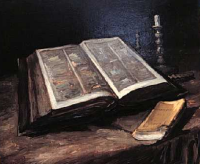
Above (left) is a reproduction of a painting by Vincent Van Gogh, which he composed in 1885. You will notice that there are two books. The larger of the two is the Bible. The other book is entitled: La joie de vivre (Joy of Life) by Emile Zola. Zola was the leading French novelist in the latter part of the 19th century. In 1884 he wrote La Joie De Vivre. It was part of a series of twenty novels he wrote rooted in a philosophical school called Naturalism. Zola helped establish this school.
In summary naturalism taught:
Individual characters were seen as helpless products of heredity and environment, motivated by strong instinctual drives from within and harassed by social and economic pressures from without. As such, they had little will or responsibility for their fates, and the prognosis for their “cases” was pessimistic at the outset.
What do you think Van Gogh was attempting to do by juxtaposing the Bible with Zola’s La Joie de Vivre? I think he was illustrating what was happening in late 19th century intellectual thought. Although the Bible was still open, it was no longer being illuminated. You will notice that the candle is not burning. Rather than the teaching of the Bible guiding life, it was now philosophies, like naturalism, that were in the foreground of intellectual thought.
Well if that was the case in 1885, I would suggest that in our own day we are facing something similar within the Anglican Church of Canada. Philosophies like naturalism are shaping our theological thought and moral conduct. And it is for this reason that our Communion is currently in crisis.
. . . more




This article states:
“In summary naturalism taught:
Individual characters were seen as helpless products of heredity and environment, motivated by strong instinctual drives from within and harassed by social and economic pressures from without.”
This is no different than Reformed Theology, isn’t it?
From popular evangelical pastor John MacArthur’s website:
“And I would suggest, maybe for discussion among us or for your thinking, that nowhere in the Bible does it suggest that man has a free will and that he acts independent of outside sources, conditions, people, et cetera. Man has a will. But Luther said it was a ‘will in bondage.’ And the Bible says that our will is always a slave. It’s either a slave to sin, or a slave to righteousness.”
“That’s where Pelagianism starts. And out of that, you get a totally graceless theology. Because ultimately, if it’s my choice, whether it be good or evil, then I can save myself. I can redeem myself, simply by choosing to be good … His love for His elect is a whole different level of love. It’s a superior kind of love. That’s what makes salvation so special. That’s what makes our relationship with Him so unique.”
I always enjoy reading the apologetics of those who do not wrestle over whether God has chosen them over the vast numbers of poor slobs consigned to eternal misery. You see, for all this talk about charity, it’s all about them. It also sets up quite a system of immunity from criticism when one is convinced they’re a “slave to righteousness”, doesn’t it?
Great catch, James.
My thesis is that John Calvin’s theology is the theological ground of a descramentalized universe. By that I mean, that the materialism of the late nineteenth century that led to naturalism, Marxism, etc. has it’s roots in the Radical Reformation.
The great (by which I mean highly influential) materialist philosophies replicate Christian thinking but without Christ, which is to say with no reference to anything beyond the material world. The question is where did the break occur? Where was the break with the transcendent? Well, it’s evident in its own way in the sermon you cited. What is the real difference between MacArthur’s definition of man (anthropology) and the naturalist definition except that in the latter God is not in the picture?
Because I believe that religion is the ground that shapes and directs culture, my view is that the corruption had to occur within Christianity first and then spread to the larger culture where the culture was shaped by the new theological ideas.
There is a lot to be said here. But I will fast-forward to the present day. We stand today at either the brink of a new dark ages, or the start of a deep spiritual renewal. Marxism, Darwinism, and all the other materialist philosophies have left the world spiritually exhausted, but the recourse cannot be to a Christianity of MacAurthur’s stripe — not in the long term anyway. The reason is that despite the exhaustion, the materialist categories still exist and since they echo the Christianity of MacArthur (because that is where they really came from), the words of MacAurthur, which is to say the Gospel of John Calvin, can provide only so much nourishment. This is not to say that MacArthur is a bad man or that the people in his church are not really Christian, or any such thing. It’s just that the culture will have to reach deeper into its past, beyond the Radical Reformation, to find the seeds of renewal.
Let me refer you to Solzhenitsyn’s Harvard Address. Pay particular attention to the last half of the essay.
Reading through my note just now I realize I could have responded better But it is getting late so it will have to wait.
An interesting thought James. I’ve looked at Reformed theology, and while I think it has much to teach us, especially about grace, I don’t think I can go there. I’m more of an Arminian myself, I guess.
Over and above that, in the eternal free-will / predestination debate, I am reminded that His thoughts and His ways are so much different than ours!
Peter
PS Up North of the border, we are Anglicans, not Episcopalians. Not that it makes any difference really, same bunch, different name 🙂
Reformed theology had its roots in Catholic humanism, which had its roots in Scholasticism which had its roots in Augustine and neo-Platonism.
In general, the west’s mistake was to jettison the work that the Church did in sorting through Hellenic philosophy, Christianizing what could be Christianized and rejecting the rest. The western theologians “re-discovered” Plato and the rest and proceeded to use pagan philosphy to form their theology rather than the other way around. The “slavery” of man is quite evident in paganism.
IMO Augustine never got over his dualism and had the Church not already been fatally split by distance and language would have been subjected to correction by the Church rather than dominating it as he did in the west.
It is the “slavery” of man in which the modern secular/Protestant mind fits so well with Islam.
Note 3. Sorry. Made the correction.
No worries 🙂
2) | May 31 2007 | Jacobse
My thesis is that John Calvin’s theology is the theological ground of a descramentalized universe. By that I mean, that the materialism of the late nineteenth century that led to naturalism, Marxism, etc. has it’s roots in the Radical Reformation.
Father Jacobse
You will remember Tom Luichinger and I from St Paul, Mn. We are presently in Lynchburg, Va – our parish is Holy Trinity, western rite. Our bishop encourages our mission, ‘you are to be fools for Christ’s sake.’ So, here I am. Perhaps it is foolish for me to speak up. However, I wish to say I am grateful for Orthodoxy Today — I read it, and learn.
I want to point out something regarding the Protestant Reformation. And ask, what is the connection between John Calvin and the Radical Reformation?
Alistair McGrath recounts three wings. 1) Lutheran 2) Calvin — these are the Magisterial reformers. 3) Zwingli, Menno Simons — these are the Radical Reformers, Separatists, non-creedal, many of them pacifists.
I thought to ask you whether you would go into it a little more, concerning your theory of tragic ‘desacramentalization.’ Myself, I can’t see that materialism has it’s ground in the theology of either of the Magisterial Reformers. [Seeing the Book of Concord, for Luther, or the Westminster Confession, for Calvin.]
One doctrine alone points the way: The total depravity of man. That desacralizes the human soul, rejects the sacramental function of man to dress and keep the earth, denies the Incarnation and leaves the world and all in it as the play thing of the devil.
Michael, those who believe in the depravity of humankind usually believe at least as strongly that people are lifted from that depravity — given worth, sustained, and enabled to do good things –by God, through Christ’s incarnation, life, death and resurrection. I’m one of the people who believes this.
On my own, I would be nothing. If I were on my own, everything you said would be true for me. I am not on my own. Through God’s grace, and only through it, the human soul sees the sacred. Through God’s grace, and only through it, dressing and keeping the earth is sacramental. Through God’s grace, and only through it, the world is no longer the plaything of the devil.
Affirming the incarnation is the human response to God’s grace.
I do not see this as a polemical issue. I mention it only because it seems to me one can believe in the total depravity of unregererate man (although I don’t usually use this language), without the dire consequences you mentioned.
Myself, I can’t see that materialism has it’s ground in the theology of either of the Magisterial Reformers.
Whereas, on the other hand — look at the exhibition of materialism, if we mean loss of the sacred, in the scorn heaped upon orthodox Christianity, by early American men of stature such as Thomas Paine and Thomas Jefferson. It was a dogfight, but I like the lack of sophisticated subtilty.
Have you read Thomas Paine’s letter to Calvinist ministers?
http://www.deism.com/paine_essay09.htm
This is crystal clear: He is mocking the Apostle Paul in candid terms. [not merely John Calvin, or Martin Luther.]
The problem with the Calvinist definition of depravity is that it robs man of freedom. Depravity, in the Calvinist definition, means man has no choice in his salvation. God decides who to save, and who to damn — double predestination. Calvinists skirt this discomfort by pointing out anything less than this undermines the sovereignty of God. God, if He is indeed sovereign, must possess this authority.
In cultural terms the theology posits a mechanistic universe where salvation really functions like a kind of deux-ex-machina, i.e.: God reaches in, does His magical work, and life goes on. You can see why after a generation or two people would wonder why there is even a need for God.
Add to this the desacrilization of the Eucharist. These ideas are best revealed in the great debates between Zwingli and Luther. Luther fought passionately for the real presence of Christ in the Eucharist — the classical understanding. Zwingli saw the Eucharist as something else, a passive exercise of sorts incapable of ministering the grace of God. Luther won the battle. Zwingli won the war.
So, posit a God so distant from created life except for those whom He chooses to save (and we don’t know they are), as well as a denial of created materiality to confer the grace and power of God, and after several generations you have a cultural awareness that mimics what the secularist believes today, except that the secularist has abstracted any notion of God from the structure.
Calvin’s god seems closer to the god of Mohamed than the God of Paul. Maybe that is why the secularists (not all but many) are susceptible to Islam.
The problem with the Calvinist definition of depravity is that it robs man of freedom.
No problem. With the definition. Depravity is depravity. Luther said the damage is unspeakable. The damage robbed man of his freedom, or rather colored it severely, giving the theologian Paul the right to use these terms: ‘dead in sin’, ‘sold in sin’ and other various terms St Paul uses. Slave, slavery. It is an orthodox given that after the Fall, man’s freedom was changed. I hope this is Orthodoxy.
Depravity, in the Calvinist definition, means man has no choice in his
salvation.
Not true. The choice was made by our federal head, Adam. I, Nancy L., and you, Fr. Hans, being in Adam, chose death. We are to count this just. I must see this as Orthodox judgement.
Luther [Book of Concord] : — This damage is unspeakable, and cannot be discerned by reason, but only from God’s Word.
Martin Luther, you sound reasonable, orthodox, and saintly. So, obeying
this and turning to God’s Word, I see in Romans 6 and 7 a discussion of sin
enslaving. We have no freedom, no liberty, apart from the Totally Free One granting it.
God decides who to save, and who to damn – double predestination.
Comes to mind, the Lord Jesus: “Rather fear him who can destroy both soul and body in hell.”
So, that’s congruent.
The double-thing is negligible — as in simple common sense. Not difficult logic. If God sets his affection upon Israel [& the Church] and calls her the apple of his eye, that means he does not also set his affection on Hagar. On those to whom he said: You are not children of God; you are children of your. father, the devil.
What. Double affection?
His love is peculiar and selective because He is more free than we are free. And he has damning perogatives. I must see this as Orthodox. Part of a beautiful mystery — and clues are everywhere: it’s about His Glory.
St John Chrysostom on Romans 9 is a breath of fresh air and so robust. After Paine’s (whining), may I say.
God decides who to save? This is certainly an offense to Paine, Jefferson, Franklin, and all apostates — to be sure! It should not be an offense to orthodox Christians. God creates out of nothing. He saves whom he wills, because he is pure Freedom, for one thing. And making my remarks ‘sacramental’, I turn to the Sacred Word, St John.
“THE WIND BLOWS WHERE IT WISHES and you hear the sound of it, but do not know where it comes from and where it is going; so is everyone who is born of the Spirit.”
Why? Because God is Free.
And turning to the Liturgy. Oh Son of God and Giver of Life — therefore all the world doth glorify You!
Why glorify? Because he is God and Giver of Life! At the least, we Orthodox should allow Him ‘saving and damning’ perogatives. We do!
Calvinists skirt this discomfort by pointing out anything less than this
undermines the sovereignty of God. God, if He is indeed sovereign, must
possess this authority.
Skirted? Rather, BOASTED!
And what a match is the glorious icon of Christ Pantrocrator in the high and lifted up dome! Lifted up! I love you Christ! But condescending is the King of Kings — see him feeding infants bread and wine with a spoon.
This is I AM and GOD IS LOVE in a most glorious magnitude. Matchless!
It’s a match! Chrysostom/Luther/Calvin and Orthodox worship!!!!
In cultural terms the theology posits a mechanistic universe where salvation really functions like a kind of deux-ex-machina, i.e.: God reaches in, does His magical work, and life goes on.
Preposterous. We have a history in America. We have a couple of Great Awakenings under our belt. You could read Jonathan Edwards sermons where he pleads with flesh and blood to TURN, TURN — why would you DIE!!!!! Pleading with humans, not machines. Don’t ask me where the haughtiness of the Paines come from:
saying:
Wouldn’t you say this comes from the Devil? I can assure you this does not come from St Paul, John Chrysostom, Martin Luther or John Calvin or Jonathan Edwards, John Whitefield or John Wesley. We will find no roots for these blasphemies in these theologians.
You can see why after a generation or two people would wonder why there is even a need for God.
Again, preposterous.
All these theologians have preached their hearts and lives out:
Trust God’s mercy! Believe on the Lord Jesus Christ! Turn from your sin! Why would you die! Warnings! Further unspeakable things than being sold in sin will happen to you. Hellfire.
Man is responsible. Calvin affirms the responsibility of man for the choice which was made by our federal head Adam. And personal daily sins simply ratify our choice further.
God is just: He said, “The soul that sinneth, it will die.” It is his mercy that this great drama of redemption history is still unfolding. And salvation is gratis. Amazing grace.
Here following, we see easily eye to eye and word for word, as regards the Radical Reformation.
And Baptism.
I believe in objective means of grace. Furthermore, the non-creedal stance of the Radical Reformation is deeply flawed and leads to unending division. And the passivity of the Separatists is another thing. I suppose a form of the monastic way might be visioned.
Yes. Just as Luther and Calvin’s views are orthodox and superior to the Unitarian thing of the Colonial era. Yet who has won the war? Look at the member churches of the NCC, the Anglican crisis. They are functional unitarians, universalists and calling a spade a bloody shovel with St Peter: false teachers. Apostate.
So, posit a God so distant from created life except for those whom He
chooses to save (and we don’t know they are), as well as a denial of created materiality to confer the grace and power of God, and after several
generations you have a cultural awareness that mimics what the secularist
believes today, except that the secularist has abstracted any notion of God
from the structure.
No. This is way off. A distant God is not posited. The whole counsel of God with particular reference to the synthesis made by the primary theologian, St Paul, is posited.
Calvin’s god seems closer to the god of Mohamed than the God of Paul. Maybe that is why the secularists (not all but many) are susceptible to Islam.
Fr. Jacobse. If you could get them to like icons, maybe the Muslims would kind of like Christ Pantocrator in the dome, as I love it. Everyone should. But think.
They are anathema to the Holy Trinity just like Paine, Jefferson and Benjamin Franklin. Anathema to I AM and Theotokos. As Udo Middlemann put it: “Allah wills it.” is a mantra with them. They don’t have a Puritan work ethic, really. There are natural resources all over Africa for them to dig out. Do you see them wiping the flies from their babies’
faces? Weakly. “Allah wills it.” This is beyond even a hyper-hyper Calvinism.
Is there justice system akin to Constantine’s Byzantium? Calvin’s Geneva? or our Puritans? Food for thought.
Most of all — what do they know of amazing grace from God Is Love? They don’t. Fearful eyes reflect their souls, and not love such as………oh, say, one of John MacArthur’s spiritual daughters,
Joni
Don’t we need more Joni’s? The remnant faithful of the Magisterial Reformers and even Zwingli-ite offspring. They are doing some things mightily right. American Vision Gary DeMar.
Douglas Wilson has built a network of Classical Christian Schools which is bursting — and will be the antidote to the passivity of a lot of otherwise well-meaning Christians, who know some things of piety — but lack discernment abilities. Who lack appreciation for connection to their own historical roots.
These children are being trained to think accurately and critically, after the manner of Basil and Chrysostom. Thinking critically — and yet, bowing humbly before the Sacred Word.
Lots of stuff here Nancy, much of which I just don’t have the time to address. Two clarifications:
Calvin’s notion of depravity is that man (Adam) fell into abject existential darkness. Not even a thought could be directed toward God. The Orthodox don’t believe this.
Because of depravity (Calvin’s definition), God must chose who is saved and who is not since salvation cannot, by definition, entail any effort or choice on the part of man. The Orthodox do not believe this.
Nancy you wrote this passage in your response to Fr. Hans:
From where did you get this quote of Luther’s from the Book of Concord? The general practice when quoting from the BoC is to quote each book separately (e.g. the Augsburg Confession, the Smalcald Articles, etc.). Why I ask is that saying Luther and BoC isn’t very clear because Luther only wrote three of the eight parts included in the book. It’s kind of like a fundie stating, “God said this or that” and then citing the Bible as a whole for the reference.
You also need to include the date when quoting Luther. In Luther studies there is an accepted understanding that Luther changed some of his views over a period of time. The best example of this is comparing his acceptance of purgatory in the 95 Theses [1517] to how he understands purgatory in the Smalcald Articles [1537]. Adding the date clarifies because Luther has been misquoted and misapplied to give some kind of legitimacy to whatever political or theological agenda is popular at the time.
Finally, this current American trend in Reformed studies to make Luther this kind of proto-Calvin distorts the reformer’s writings and history. You need to separate your Reformed impression that Luther and Calvin are somehow synonymous thinkers. They’re not. Luther had a theological understanding that led him to very different theological conclusions to Calvin’s, as evidenced in the understanding of the means of Grace between the two (shown by his quote to a friend a few days before his death “Blessed is the man that walketh not in the counsel of the Sacramentarians, nor standeth in the way of the Zwinglians, nor sitteth in the seat of the Zurichers.” [1546]). There is also a wide difference in the understanding of Sola Scriptura between the two. Luther sees a question of, “what has God done for my salvation” and finds it in Scriptural revelation. Whereas Calvin asks the question, “What must I do to the greater glory of God?” And reduces Scripture to a book about God’s will for man’s conduct and belief.
Even today Lutheran scholars see Reformed theology as a legalistic approach to Scripture. It could be said that there is very little difference between Calvinism and Romanism, in that; Rome wants men to submit obediently to the voice of the church. In Calvinism it is a blind obedience to the Bible. It’s kind of hard to tell the difference at times between the two legalistic ideologies.
Lots of stuff here Nancy, much of which I just don’t have the time to address.
I appreciate and respect that.
Two clarifications:
Calvin’s notion of depravity is that man (Adam) fell into abject existential darkness. Not even a thought could be directed toward God. The Orthodox don’t believe this.
Because of depravity (Calvin’s definition), God must chose who is saved and who is not since salvation cannot, by definition, entail any effort or choice on the part of man. The Orthodox do not believe this.
Thank you. Regretfully, I cannot honestly say crystal clarity, as abject darkness pictures the very spiritual death, Ephesians 2, from which there is ‘quickening’ made. I do not know why there should be difficulty.
As for the doctrine of election, there is much scripture. And meant to help us know God truly.
I pray for America: St. Ignatius of Antioch “Being come together in the same place, let there be one prayer, one supplication, one mind, one hope, in love and in joy undefiled. There is one Jesus Christ, than Whom nothing is more excellent. Therefore all should run together as into one temple of God, as to one altar, as to one Jesus Christ, who came forth from the Father, and is with and has gone to one.” (The Ante-Nicene Fathers Vol. 1; Eerdmans pg. 56)
From where did you get this quote of Luther’s from the Book of Concord?
This damage is unspeakable, and cannot be discerned by reason, but only from God’s Word.
It’s under Original Sin, Affirmative Theses, #9
Epitome of the Formula of Concord
The general practice when quoting from the BoC is to quote each book separately (e.g. the Augsburg Confession, the Smalcald Articles, etc.). Why I ask is that saying Luther and BoC isn’t very clear because Luther only wrote three of the eight parts included in the book. It’s kind of like a fundie stating, “God said this or that” and then citing the Bible as a whole for the reference.
You also need to include the date when quoting Luther. In Luther studies there is an accepted understanding that Luther changed some of his views over a period of time. The best example of this is comparing his acceptance of purgatory in the 95 Theses [1517] to how he understands purgatory in the Smalcald Articles [1537]. Adding the date clarifies because Luther has been misquoted and misapplied to give some kind of legitimacy to whatever political or theological agenda is popular at the time.
JBL, thank you. I see what you are saying, I did not realize that about authorship.
Is it your hunch that this is not Luther’s belief?
Finally, this current American trend in Reformed studies to make Luther this kind of proto-Calvin distorts the reformer’s writings and history.
Council of Orange, 529 AD — is it not proto to the reformers concerning original sin and grace? I would like to understand why John Cassian, as a semi-Pelagian, seems slightly more – influential? – for the Orthodox? Is this the case?
I did notice Luther’s Bondage of the Will was translated to English by J I Packer.
You need to separate your Reformed impression that Luther and Calvin are somehow synonymous thinkers. They’re not.
Lord, have mercy. Have we known synonymous thinkers?
My roots are not actually Reformed. A pietist movement out of the
Lutheran Church/Sweden. The name of the denomination is the Baptist General Conference, Bethel College. True, in my non-liturgical world Luther-Calvin seemed an entity of thought – the 5 solas.
Then came John Piper, my pastor just previous to meeting my husband and becoming Orthodox. Piper was different. He preached Romans, and I had no idea I was learning such a red-flag thing as “Calvinism.” But that was the case, and I was to tell him later that the God-centered theology (which served to heal some trauma in my life) evangelized me to Orthodox worship.
I have spent time in the Presbyterian Church in America & L’Abri, some. I was made aware that Luther is not Calvin (for the first time) by a WELS pastor who gave me a book by Gregory Lee Jackson.
But looking through the lens of all church history – and stepping back a little; so far I see things generally. Generally agreed. I don’t know that I will have any reason to go into minutia of differences, in complex America. Or all the various movements of the church.
My eye is on the Head of the Church who prays harmony of his own in the Gethsemane prayer — He is doing a marvelous and awesome work, bringing the drama of redemption forward. He’s making his church, ‘household of God’, ‘without spot or wrinkle.’ If I can’t see it; nevertheless, it’s written. And I aim to be less of a fault-finder.
Nancy L writes: “As for the doctrine of election, there is much scripture. And meant to help us know God truly.”
On a side note, I’ve never met anyone who believed in the doctrine of election who didn’t coincidentally believe themselves to be among the lucky elect.
In any rate, there’s a logical absurdity in the doctrine. It asserts that God wills that most people remain at odds with Him throughout eternity, that He forever wills that they do not do what He wills.
I appreciate Lewis Carroll, but I prefer this sort of logic stay in Wonderland.
Nancy wrote:
It was my hunch that it wasn’t Luther’s words. Luther may have agreed with it. But it would be hard to prove since the passage you cite was written some 30 plus years after Luther’s death.
The Formula of Concord Epitome was written Jakob Andreae, he was part of the second generation of Lutheran scholars. He, along with Martin Chemnitz, were the primary editors of the Formula of Concord (also Andreae wrote the letters to the Patriarch Jeremias II in Constantinople in an attempt to open dialogue between the German reformers and the Orthodox).
The Formula was written as a reaction to the crypto-Calvinist movement that had been going on in certain areas of Germany. The primary purpose of the Formula is to reject Calvinism. This is clearly seen in the Solid Declaration’s article XI The Eternal Foreknowledge and Election of God.
The reason why the passage you cite sounds like it’s in line with the Church Fathers is because it probably is. The writers of the Formula were known for their early church studies, especially Martin Chemnitz.
If you want a better understanding of Luther’s interpretation the Fall and Original Sin then look at the Large and Small Catechisms, plus the Smalcald Articles. Or, his commentary on Genesis.
Very helpful — thank you! See you in some days
— Nancy.
On a side note, I’ve never met anyone who believed in the doctrine of election who didn’t coincidentally believe themselves to be among the lucky elect.
In any rate, there’s a logical absurdity in the doctrine. It asserts that God wills that most people remain at odds with Him throughout eternity, that He forever wills that they do not do what He wills.
I appreciate Lewis Carroll, but I prefer this sort of logic stay in Wonderland.
To James K.
What you write, James, sounds foreign, but I am interested in your criticism. Lucky elect You wrote earlier: poor slobs consigned to eternal misery. I’ve not heard these sentiments before, but by that I do not mean I have never heard mocking. I do not say your are mocking.
I would like to communicate about all your words. I would be helped if you might please relay a true to life example for me — where you have heard or seen written this sentiment or perceived it in attitude. Are you saying it is pervasive? For example, Billy Graham? Please elaborate. It would be helpful to know your faith, your confession. Are you Orthodox?
Nancy, I have had many, many discussions (mostly online) with people who declare themselves to be of the Reformed faith, mostly Calvinists. I am not suggesting they are “bad people”, and most of them probably do a great deal of good, but there seem to me to be dangers in taking their system of beliefs to their logical conclusions.
There are several things I take issue with:
a) The idea of man’s completely passivity. Calvinists insist that man is either a complete “slave to sin” or a slave of God. They deny the concept of free will altogether. Yet, they assert that man, despite having no capacity to choose, is rightly condemned to eternal damnation. While I understand the meaning of “compulsion”, I don’t believe that man is completely devoid of some freedom to choose. Additionally, I don’t think I could declare “good” a God who punishes eternally someone who had no choice but to be other than what they were. It would be similar to a parent severely beating a blind and deaf infant for not having responded to the parent to clean their room, knowing full well the child could not see or hear them!.
b) The worship of God’s “sovereignty” above all other of His attributes. The priority of this makes it necessary to see God’s hand not only in good but in evil, that His will is done not despite evil but because of it. Thus, the shooter at Virginia Tech, while defying God’s “immediate” will as defined in Scripture, was actually doing God’s “ultimate” will as decreed in the beginning of eternity. So you end up with the illogical concept of having one will of God competing against another. Further, taken to this logical conclusion, you do what people like the Phelps’ family does: a tornado destroy several hundred lives? It’s God’s will, so praise God! If an Iraqi insurgent kills several troops, thank God for it. Of course, this is an extreme position, but in my discussions with Calvinists, there is an element of callousness there in the sense that the bad that happens is to a “good God’s” pleasure against a humanity that is “totally depraved” and worthy of whatever’s coming to them. I’m not suggesting this lack of empathy is shared among all of the Reformed faith, but it seems to be a recurring problem.
As far as Billy Graham and the like, I don’t think he’s considered “Reformed”. His theology actually seems quite orthodox.
I was raised Catholic and, although I can’t say I am in agreeement with all Catholic doctrine and theology, it’s what resonates with me more than any other theology and seems the one most grounded in a true understanding of humanity.
You might the following critique interesting.
JamesK
Dear Depraved James,
My name is Miss Lucky Elect Lucy. You are Sir James Kilpatrick. Regretfully it seems to me you fail an important test as concerns the doctrine of the assurance of salvation. You seem to stutter a bit when you pray the Lord’s prayer (not knowing for sure! whether or not you should call God “father”). I have no other choice than to deem you in company of the poor slobs consigned to eternal misery.
With God’s love,
Saint Lucy L.
p.s.
I will be busy tomorrow, “probably doing a great deal of good!”
🙂
May I say, I hope your exchanges were not that snooty
Polemics are either terribly enlightening! — or on the other hand: here we go around the mulberry bush for 1500 years. But, I will read your link of a reformed Reformed.
An (-ism) often looks good on paper — even a superficial look at Communism. I think my bottom line will always be something like this: Back to the Bible on bended knee. Because God never fails to meet me there. [not to mention the very special Lord’s Day and preaching of the Word.] May I know you and follow you. May I take up the cross you give me, and not one of my own choosing. Grant me the strength to bear the fatigue of the coming day. Pray thou thyself in me.
I am sure all have saints with whom we want to hold conversation in the next world. Two of hundreds and hundreds for me are Martin Luther and John Calvin — It’s like love; I could not tell you every reason why.
If it is our privilege with David to count our blessings publically — I will do so. What is the risk, oh fool? That people will think you boast. That you see you are privileged. But I cannot invent another life. Why was I not born on the streets of Calcutta? Or worse. Ruth Graham, daughter of Presbyterian Reformed medical missionaries says, “My parents taught us the faith and lived it. Therefore it was easy as a child to begin early learning to trust the Lord Jesus with all of life.”
And it makes you think: difficult? even seeming impossible? Yet, with these others is where God’s power is most clearly seen. With me, there is self-righteousness, so God’s power is seen in his perfect chastening and humblings, and he does so with perfect knowledge as a perfect father, and any response of mine I freely acknowledge is “him working in me, both to will and to do his good pleasure.”
Non nobis, Domine
Sincerely